A clean energy future for whom?

Fergus Green unpacks the carbon pricing package to discover, at its core, a tension between fundamentally different visions for the future of Australia’s economy and environment

13 July 2011


Print this article Print this article

Tags: , , , ,

Bookmark and Share

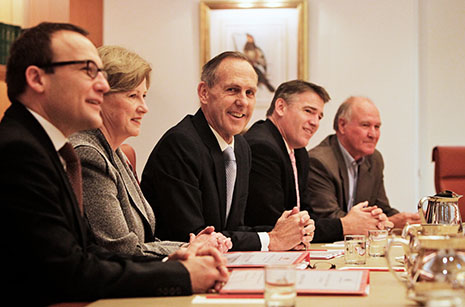
Above: The Multi-Party Climate Change Committee meets in Canberra on the day the government released its carbon plan.
AAP Image/ Andrew Meare

THE federal government wants to convince us that its new carbon price package creates a “clean energy future” for Australia. If you’re wading through Sunday’s avalanche of announcements in search of a clear policy signal to this effect, though, you won’t find it. The incentives in the package pull the economy in contradictory directions. But searching for policy coherence is a misguided exercise. It’s better to think of the package as the chaotic aftermath of the first real battle in a long war over the future composition of Australia’s economy and environment in a warming world.

I say the first real battle because, although various political parties and social groups have always held visions for our collective future that differ fundamentally from the political mainstream, the negotiations over the carbon package mark the first occasion on which such an alternative vision has been expressed through a political party with sufficient power to influence a major economic and environmental reform, at least at the federal level.

Until the Greens took the balance of power in both the House of Representatives (along with some green-minded independents) and the Senate (in their own right), the battle for Australia’s future was a one-sided bloodbath. Labor, the Coalition and Australia’s business and policy elite have long shared a basic commitment to the rapid and far-reaching expansion of fossil fuel consumption and production – for domestic use and for export – in Australia. During the debate, such as it was, over the Carbon Pollution Reduction Scheme, none of these parties or groups challenged this deep brown vision for Australia’s future. Rather, the issue was whether or not to give it a green-tinged veneer by adopting a weak emissions trading scheme so riddled with loopholes that its only notable effects would have been to entrench the fossil-fuelled status quo, waste more than $20 billion of taxpayers’ money in unjustified handouts to the biggest emitters, and distract from Labor’s commitment to double Australia’s coal exports over the next decade or so.

Unsurprisingly, Labor’s strategic commitment to a brown Australia has not changed in the eighteen months since the demise of Kevin Rudd’s scheme. Before the last election, Prime Minister Gillard ran on a “no carbon tax” platform. She had to be dragged into carbon policy negotiations by the Greens as the price of their support to form government. Since they’ve been at the negotiating table, it is no secret what Labor has fought for: a low carbon price; an early switch to a cap-and-trade scheme with a low emissions reduction target of 5 per cent below 2000 levels by 2020; ludicrously high compensation to the “big polluters” it now pretends to demonise; the exemption of petrol from the scheme; extensive reliance on less-secure land sector credits from the Carbon Farming Initiative; and insubstantial (if any) new complementary measures for renewable energy. Most importantly, Labor has maintained its commitment to allow Australian emitters to “outsource” their emission cuts (to rely on imported carbon credits from abatement activities in other countries, which are expected to be significantly cheaper than Australian carbon permits, to acquit their carbon liabilities) so they can keep polluting here.

The key difference this time is that the Greens were on the battlefield fighting for a different vision: a genuine clean energy future for Australia. They have, accordingly, fought for measures that would spark a structural transformation of the Australian economy: a well-designed carbon price scheme with a higher carbon price during the fixed price phase, as well as scientifically credible emissions targets and stringent caps on outsourcing during the cap-and-trade phase. They have also advocated investing the (necessarily higher) projected revenues from such a scheme into essential complementary measures to develop renewable energy industries, establish twenty-first-century infrastructure, improve our woefully poor energy efficiency record and conserve our natural environment and biodiversity.

In the resulting package, there is no clear winner. The mish-mash of carbon pricing, tax changes, grants schemes, investment bodies, commissions and inquiries reflects gains and losses on both sides.

Labor’s vision is more apparent in the carbon price mechanism itself – with the early switch to cap-and-trade based on the default 5 per cent target that will allow extensive international and land sector offsets – and in the industry compensation package which, at more than $22 billion over the next six years alone (including the “government-only” measures for gassy coal mines) is arguably more wasteful than the Carbon Pollution Reduction Scheme. The Greens’ main mark on the scheme is evident from its governance arrangements – particularly an independent Climate Change Authority, which will recommend emissions targets, and Productivity Commission reviews of industry compensation and fuel tax arrangements. These innovations will both enable, and build political pressure for, deeper cuts and less wasteful compensation in the future.

In the package of complementary measures, however, it is the Greens who have emerged ascendant. With a $10 billion clean energy investment corporation, a new agency to administer $3.2 billion worth of renewable energy grants, funding for a negotiated closure of 2 gigawatts of the dirtiest power plants, and a prohibition on using any of these agreed funds for carbon capture and storage projects, the Greens have peeled back the coal industry’s fig leaf and tipped the balance of low-emissions technology development in favour of renewables.

THE biggest battle, however, is yet to come. Australia now has a target of achieving 80 per cent emissions reductions below 2000 levels by 2050, yet it seems unlikely we will achieve any more than the default 5 per cent target by 2020. This means that around 94 per cent of our emissions reduction burden from now until 2050 will need to be shouldered after 2020. Accordingly, rules that govern how much Australian companies are allowed to outsource their post-2020 emissions liabilities will essentially determine whether the scheme will bring about a clean energy future for Australia or whether we’ll be stuck with fossil fuels and a massive bill for imported offsets.

On this most important of matters, the new carbon price package provides no guidance. While liable emitters will be prevented (thanks to the Greens) from acquitting more than 50 per cent of their carbon liability with international offsets, this restriction only applies until 2020. From then on, the policy papers simply say that the 50 per cent quota “will be reviewed” by the Climate Change Authority in 2016. This fudge is telling: it shows that neither Labor nor the Greens were willing to compromise on their respective visions for Australia’s future.

Treasury’s modelling, released as part of Sunday’s package, gives a sense of what is at stake. Treasury projects that Australia’s emissions will exceed one billion tonnes of carbon dioxide equivalent by 2050 – a staggering 80 per cent higher than Australia’s emissions in 2000 – under a “business as usual” scenario (that is, without a carbon price). To achieve the agreed target of 80 per cent below 2000 levels by 2050, Australia will, on Treasury’s models, need to cut emissions by 897 million tonnes below the business as usual figure. Treasury projects that, by that time, 434 million of those tonnes per year (nearly half of the required abatement) will be outsourced to other countries under an Australian carbon pricing scheme in which there are no restrictions on the importation of international offsets, leaving Australia’s actual emissions in 2050 almost exactly where they were in 2000, at around 550 million tonnes. Some “clean energy future” that would be!

The Treasury modelling does not take account of some of the final details agreed to by the Multi-Party Climate Change Committee, including the 50 per cent quota limit on outsourcing that will apply until 2020. Treasury will therefore be producing updated modelling to reflect the final agreed package.

Given the fundamental importance of the outsourcing restrictions beyond 2020, and the fact that this issue is now deeply politically contested, it is no longer appropriate for Treasury to take a normative stance on the desirability of outsourcing – let alone without a quota. For example, in Chapter 5.2.2 of its modelling, Treasury claims that “while pricing carbon cuts domestic emissions, it is inefficient to meet the whole abatement task through domestic abatement.” But this comment presupposes the very question that is now at issue: the nature and content of the “abatement task.” If the task is to finance 900 million tonnes of abatement wherever in the world it may be cheapest then, yes, outsourcing is obviously an “efficient” way to do that. If the task is a clean energy future for Australia and an 80 per cent reduction in Australia’s emissions, then outsourcing is not an option, let alone an efficient one.

Treasury should, in its next attempt, model scenarios across the full range of “outsourcing” assumptions: for example, one with “no outsourcing allowed,” one with “no restrictions on outsourcing” and one with a “50 per cent outsourcing restriction.” This way, Australians can openly debate the merits of these competing visions for our economic future (though preferably with a little less hypocrisy than the opposition and a little less expediency than the government).

Some will retort that cutting that much carbon pollution entirely in Australia would be too costly or that it is some kind of green fantasy. Intelligent Australians should resist the temptation to accept this nonsense. For example, Professor Warwick McKibbin – a Reserve Bank board member and formerly John Howard’s emissions trading adviser – has long argued against allowing any outsourcing in an Australian carbon pricing scheme. Writing in Monday’s Age, McKibbin argues that relying on international offsets for even half of Australia’s abatement “has both an environmental risk… and an economic risk.” These risks are well known and have been amply discussed elsewhere.

Moreover, a well-designed domestic scheme that clearly required the 80 per cent reduction target to be met from domestic cuts, along with appropriate complementary measures, is likely to be achievable at a quite reasonable cost and would also send a clear signal to invest in renewable energy and give Australia a competitive advantage in the low-carbon global economy. As McKibbin notes, the lack of clarity about future outsourcing rules means the government’s new scheme sends no such clear signal, making investments in clean technologies more risky (and therefore more expensive) than need be the case.

Those who support the vision of a real clean energy future for Australia would do well to target this issue. One the first priorities for environmental groups after the new scheme is enacted should be to develop a long-term campaign strategy for securing a prohibition on post-2020 international outsourcing in the carbon pricing scheme. Urging Treasury to model a range of “outsourcing” scenarios, as discussed above, would be a good start.

More broadly, drawing public attention to this obscure but fundamental issue of outsourcing would help to alert Australians to the reality that the new scheme, on its current settings, will not necessarily produce a “clean energy future” at home – and it certainly won’t do so if Labor has its way. What matters is that at least this scheme has enough green armoury in it to give that vision a fighting chance. For that reason alone, intelligent and green-minded Australians should support it – but they shouldn’t down their weapons just yet. •

Fergus Green is a climate change lawyer and policy analyst.

Share this
Email Facebook Twitter Plusone Pinterest Linkedin

Related articles

Follow Inside Story

Subscribe to Inside Story’s free weekly newsletter

Just enter your email address below, and make sure you click the confirmation link when you receive an automatic email from us:


11 Comments

  1. Graham Hughes added this comment on 13 July 2011 | Permalink

    I am seeking clarification of the mathematics involved that will induce major polluters (carbon emitters) to reduce their emissions.
    Will the $23 per tonne of carbon (carbon dioxide?)emission be tax deductable?
    Will the (net)added cost of the Tax be passed onto consumers via highes charges for electricity etc?
    If the answer is yes to both of these questions then the company profits (of these major polluters)remain unchanged & there is no incentive to reduce emissions.
    Would you please comment & clarify this?
    Sincerely
    Graham Hughes

  2. Sean Kelly added this comment on 13 July 2011 | Permalink

    Hi Graham,

    A business cannot pass on price increases with no consequences for demand for their products and services. Put simply prices go up people demand less. The degree to which demand changes in response to price changes is described as price elasticity of demand. Products with many substitutes and producers are more elastic as consumers have options to swap when price changes.

    Whether they choose to pass on price increases or not it affects business bottom lines. Either you pass on the price increase and suffer decreased demand for your product or you absorb it in your margins and enjoy increased demand as consumers move away from competitors who did pass it on. In total the amount of a tax or subsidy that is passed on is governed by the relative price elasticities of demand and supply. Thus companies will either produce less in total and thus less GHG or make their production cleaner and produce less GHG. Either way production will shift to lower-emission providers.

    Your local library will generally have some introductory micro-economic textbooks which explain with diagrams that make the concept clearer than I can here.

    Cheers,

    Sean

  3. James Wight added this comment on 13 July 2011 | Permalink

    Your assessment of the carbon price/clean energy package is similar to my own. There are built-in mechanisms to strengthen the weak target, and phase out the unnecessary and counterproductive compensation to polluters. But I’m still worried about this issue of international offsets. It’s been a problem with the Australian Government’s climate policy since 2008, so I’m happy to see it finally receiving some attention.

  4. Peter Antony added this comment on 13 July 2011 | Permalink

    Out of interest, do you have a reference for this assertion? I would like to under the analysis involved:

    “Moreover, a well-designed domestic scheme that clearly required the 80 per cent reduction target to be met from domestic cuts, along with appropriate complementary measures, is not only likely to be achievable at a quite reasonable cost…”.

  5. Alex Lamb added this comment on 13 July 2011 | Permalink

    Great article Fergus! I think it’s a start. I wasn’t thinking ‘the first real battle’ but rather the beginning of growth.

    Also, I think developing countries do need help in greening up their industries, and after all we do consume a lot of what is produced elsewhere. If AusAID already gives aid to improve the natural environment in developing countries, do you see potential here for collaborative work?

  6. John Bennetts added this comment on 13 July 2011 | Permalink

    This article accurately states that this starting towards a price on CO2 emissions is the first battle of a long war.

    Perhaps the second will be sorting out (ideally, eliminating) exporting and im porting of carbon emission credits. I’m with McKibben on that one.

    My guess as the third battle is/will be regarding nuclear power as a low energy alternative to the “do nothing” option. Agreed – 80% reduction by 2050 wrt 2000 emissions, instead of 80% increase will be difficult.

    It means that, for every 100 tonnes of CO2 emitted in 2000 (and thus about 105 right now), the figure must be lopped to only 20 tonnes. The Greens, unfortunately, tend to have closed minds about the carbon cost of constructing all those renewable solar and wind generators and have equally closed minds about the merits of nuclear power.

    My intention here is not to argue the pro’s and con’s of nuclear, rather just to state that I see nuclear as being a much quicker and more reliable way to reduce CO2 emissions as part of a mixed package of demand management, renewables and anything else that can help us to meet our objective than the alternative, which is to rely on demand management and renewables alone.

    So, Battle 3 it may well be, in which case the health of the planet may well rely on the Greens being defeated on that one… somewhat paradoxically.

  7. don owers added this comment on 14 July 2011 | Permalink

    Is it really possible to provide a figure for the GNI, or indeed any data, up to the year 2050 when there are so many variables, like climate change and peak oil that seem to have been ignored? Also the data provided assumes that our emissions from electricity will increase by 60% and total emissions will top a billion tonnes by 2050 in the absence of any carbon price. According to government figures our population will increase to 35 million by that date so despite any carbon reduction achieved per capita our national increase in emissions will have risen by some 70% due to population growth. Strangely no one seems to mention this, yet the easiest way to reduce our national output of GHGases is to adopt a stable population, something that the Minister for Sustainable Population Tony Burke MP managed to resist.

  8. Fergus Green added this comment on 14 July 2011 | Permalink

    Hi all,

    Thanks for your comments to date. In response:

    - Peter, if you check back to http://www.aar.com.au/pubs/cc/index.htm either on Friday or early next week there should be an article on the tax treatment of carbon permits by one of the tax partners at Allens Arthur Robinson – my expertise does nto extent to tax matters, I’m afraid (NB, the carbon price is not a tax as far as that concept is understood as a matter of law, so, even though the new scheme is commonly referred to as a “carbon tax”, it is really a sui generis regime that has its own legal concepts and quirks – carbon pricing/emissions trading is my area of expertise, not “tax law” per se [ie GST, company tax, income tax etc.] )

    - Alex, I definitely think there is scope (indeed, a moral obligation, given our relative wealth and our massive contribution to the climate problem) for Australia to play a big part in both adaptation and mitigation assistance to developing countries. Although I am in principle opposed to using international offsets as an alternative to reducing Australia’s own emissions, I strongly believe we should use some of the revenue generated from our scheme (of which there will be a lot more if we don’t rely on imported offsets, for which the money will go overseas) to assist other countries reduce their emissions, develop sustainably and adapt to climate change. Indeed, the whole concept of offsetting is premised on the assumption that it’s acceptable for us not to reduce all of our own emissions, whereas the science is so dire that we actually need to reduce our own emissions rapidly AND help other countries reduce theirs. This is a major (though certainly not the only) reason why offsetting should be prohibited and why we should think abatement “the abatement task” differently.

    - Peter, I concede I don’t have any quantitative evidence for that comment. But nor have I seen any analysis suggesting that the costs of an 80% (or even a 100%) reduction in Australia (ie. with no offsetting) would be prohibitive or even unreasonable, under a well-designed scheme. Of course, what is reasonable and what is excessive are both inherently subjective concepts. My view is that, given the urgency and consequences of climate change, it is absurd that we are haggling over a few dollars for a substantially different outcome. We are one of the wealthiest nations on Earth and a well design scheme with suitable complimentary measures would, I am very confident, ensure the cost increases were quite manageable. Keep in mind how much we spend on national defence, intelligence agencies and so forth to protect us from risks that are far smaller and less probable than those associated with climate change – and these untold billions get spent largely without much public scrutiny. We also waste tens of billions of dollars, at state and federal level, subsidising fossil fuel use. On both of these issues (national security spending and fossil fuel/emissions-intensive industry subsidies), Bernard Keane at Crikey has done some excellent, very detailed analysis. Of course, there are members of our society who are genuinely poor and they should not be made worse off through any such climate measures. It is eminently possible, however, to design a system that doesn’t compromise (indeed, actually improves) social equity while still achieving the climate policy objectives we need.

    - John, I don’t profess expertise on the economics of nuclear, and as in all matters of human inquiry I agree that it is best to maintain an open mind and to assess everything on its merits rather than based on an inflexible position. But my sense is that given how fast solar PV and thermal are coming down the cost curves, and all of the associated costs and problems with nuclear, we would be much smarter to invest in renewables, which most certainly can provide the power we do and will need. Again, it’s a matter of what we’re prepared to pay. But in the context of our highly developed and sophisticated economy – I think any such costs would be a drop in the rapidly rising ocean!

  9. Peter Antony added this comment on 14 July 2011 | Permalink

    Fergus

    Thanks for your reply.

    You write that “[i]f the task is a clean energy future for Australia and an 80 per cent reduction in Australia’s emissions, then outsourcing is not an option, let alone an efficient one.”

    I think my counter-argument is best articulated by considering the reasons why a clean energy future makes economic sense for Australia. It makes sense for Australia when our trading partners have acted such that having a clean energy economy is not a competitive disadvantage, and indeed may be a competitive advantage. It certainly doesn’t make sense in a future world where major emitters have not priced carbon, given that our total emissions are so low that even by taking the protectionist route, a clean energy future in Australia alone won’t make any difference to climate change.

    But in hypothesising a future world that has priced carbon, shouldn’t we also assume that the defrauding of international carbon reduction/offsetting measures would be credibly addressed?

    As the price of cutting carbon is not constant across the economy, it will be cheaper at some point along the continuum toward 0% emissions (absolutely, or with offsets) to purchase foreign cuts or offsets. In this case, it seems to me that the lowest-hanging fruit should be picked first.

  10. Greg Foyster added this comment on 14 July 2011 | Permalink

    Excellent article – nice to see an argument with links to sources, rather the baseless rhetoric that so often passes for opinion these days.

    I wasn’t aware of this outsourcing loophole post-2020, and it does seem a cunning way of shirking domestic responsibility. At this point, though, I think those who broadly support the Government’s package would be wise to keep quiet until the legislation passes…and then raise the issue with the newly established Climate Change Authority later.

    On the topic of nuclear vs renewables, I have found Stewart Brand’s new book ‘Whole Earth Discipline’ illuminating – he argues that nuclear fission is still the most economic way to wean ourselves off coal and says that the risks have been overblown.

    I’m not entirely convinced, but it’s worth a read.

  11. John Bennetts added this comment on 17 July 2011 | Permalink

    Fergus,

    Thanks for the response.

    While I do expect that nuclear power will have to do much of the heavy lifting when it comes to reduction in CO2 emissions locally and globally, it was not my intention to get into a pro-nuclear discussion at this time.

    Rather, my point is that the political reality in Australia is that the time for discussion of nuclear options will not be unless and until more readily acceptable alternatives have been seriously tried. Renewables, in all their forms, have to be pushed to their limits asap, including being given a red-hot chance to achieve lower costs. On that we appear to agree.

One Trackback

  1. [...] At Inside Story Fergus Green argues that Labor and the Greens have different visions for emissions reduction. Labor wants to allow Australian emitters to ‘outsource’ their emission cuts by buying carbon credits from overseas, while the Greens are pushing for “a genuine clean energy future for Australia.” [...]

Send us a comment

We welcome contributions about the issues covered in articles in Inside Story. We ask contributors to provide their full name for publication, but if for any reason you need to use a pseudonym please submit your comment to us via email. Because all comments are moderated, they will not appear immediately. Your email address is never published or shared. Required fields are marked *.

*
*