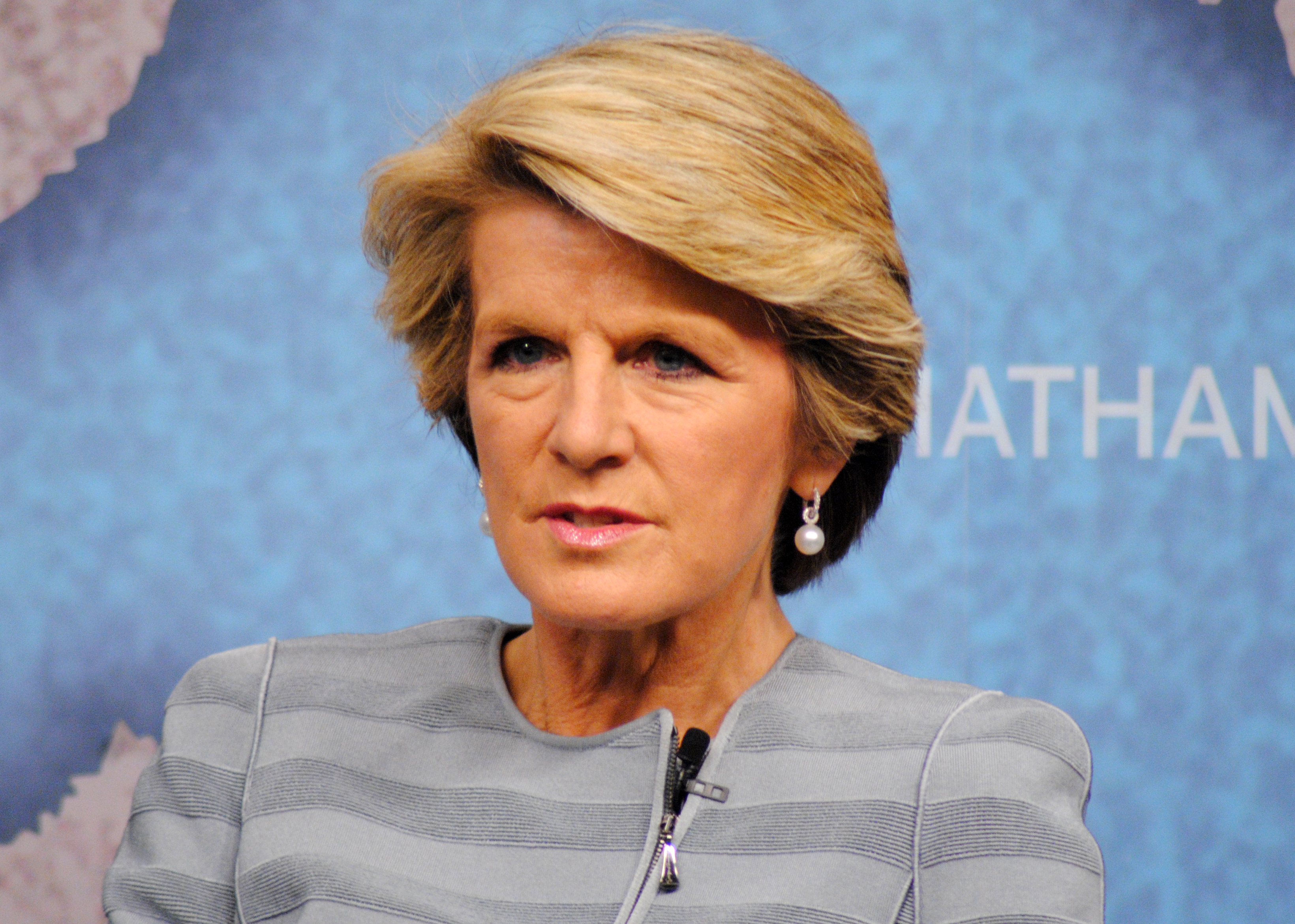
TO BE FAIR, the Liberal Party is not above admitting to error. After all, it sent Brendan Nelson packing almost before he had organised his office furniture. But a bigger question remains: did the party get it doubly wrong when it opted for the Nelson/Julie Bishop ticket? The longer Bishop remains as deputy leader and shadow treasurer, the worse the problem gets. A political lightweight is one thing, but a political liability is something else altogether. The former can be (and is) tolerated; the latter cannot be.
The Julie Bishop saga is illuminating because it illustrates an apparent paradox, that an ordinary performer in good company can look better than he or she is. The fact that she rose steadily if unspectacularly through the ranks of government created the impression of talent.
The operation of the Peter Principle is by no means unusual in politics. A good example in Liberal years gone by is that of Billy Snedden, who lucked into the late Menzies government as a youngish man among greying veterans, working his way up to become treasurer and deputy leader in the terminal McMahon government. Snedden was a likeable plodder, but he gave the impression of more. So, in desperation after their loss to Whitlam in 1972, the Liberals turned to him to lead what was, in effect, a dispirited and squabbling rabble. As a working class boy who’d made it, he had some superficial attraction for a party desperate to shrug off its born-to-rule tag.
But Snedden never cut it. The cartoonist Larry Pickering dubbed him Mediocre Man, and the electorate concurred. He led the party to just one election, in 1974, which he famously denied having lost; it was just that he did not get enough votes. His political nadir was reached during a heated debate in the House of Representatives, to which his most memorable contribution was an interjection: “Woof, woof!” Even his few remaining supporters openly cringed at that. (Bishop’s cat-claw gesture in parliament rivals Snedden for parliamentary eloquence.)
But Bishop remains a protected species – for the time being, at least. First, her elevation owes much to an attempt by the Liberals to counter the obvious appeal and high profile of Labor deputy leader, Julia Gillard. Despite the obvious chalk and cheese comparison, can the Liberals be seen to be demoting one of their very few senior women?
Second, the party’s collective judgement would be called into question. Why was she allowed to survive as deputy when Nelson was toppled? Why was she not even challenged? It was a tacit endorsement of her standing.
Third, Malcolm Turnbull’s own judgement is also on the line. He had seen her at close quarters in both parliament and party room, and while a Liberal deputy traditionally has choice of portfolio, why did he not dissuade her from succeeding him in the difficult shadow treasury portfolio?
Fourth, and this helps to explain Bishop’s curious flip-flopping early this year on workplace relations policy, her own electorate of Curtin is heavily influential in both fund-raising and policy input. (A Liberal insider drew my attention to the fact that three of the party’s top four donors are Bishop’s constituents.)
Finally, the Liberals and sections of the media have made what I regard as a quite erroneous call in nominating the treasurer, Wayne Swan, as the government’s weak link. Swan is a seasoned political veteran, mentally tough and intellectually secure. The Liberals would be better fearing him rather than underestimating him. (Interestingly, the Labor Party made a similar mistake some years ago when Peter Reith was shadow treasurer under Hewson. Labor failed to recognise Reith’s political toughness and wasted much parliamentary ammunition on a target who was as thick skinned as they come.)
There is much to question in regard to Bishop’s own judgement. In 2001, she was party to a bizarre deal in the faction-ridden West Australian Liberal Party designed to position her as successor to the embattled Liberal leader Richard Court by doing a swap with factional opponent, Colin Barnett (who is now premier). Barnett would take Bishop’s seat in Canberra and she would take over the state party. The arrangement collapsed under the weight of its own absurdity.
As education minister, Bishop was prone to exaggeration and hyperbole. Without offering any evidence, she claimed that the states had “ideologically hijacked school syllabi” and were wasting $180 million in unnecessary duplication. In an attempt to grab a headline for the former claim, her office issued an advance media kit for a speech which claimed parts of the present state education curriculum came “straight from Chairman Mao.” When the speech was delivered, the reference was quietly omitted.
My academic colleague Peter van Onselen (whom Bishop has bizarrely attacked for his “unhealthy obsession” with her) is quite right to take her to task over her chapter in his book, Liberals and Power. Her sins of omission and commission in that case compound exponentially. For a start, she assigned the writing of the chapter to a staffer, but was happy to have it published under her name. Secondly, not even the staffer could be bothered writing original material, and instead regurgitated a decade-old speech on industrial relations by a New Zealand businessman. Finally, and most damningly, Bishop appears to have not a single thought about how the Liberals can find their way back into political contention and national relevance.
If Julie Bishop is the Liberals’ future, the party is in far more trouble than it realises. •