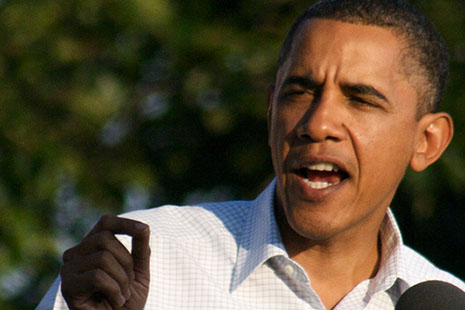
WITH LESS than three weeks remaining before the US mid-term elections, Republicans and Democrats are framing the vote in starkly different terms. Republican strategists paint it as a national referendum on Barack Obama and his party; Democrats are working feverishly to make the contest all about local issues. The outcome will determine whether Republicans take control of the House, the Senate or both. It will also profoundly affect President Obama’s agenda for the next two years.
Across the nation communities are confronting high rates of unemployment and home foreclosures, and it’s this threat to the American dream that underlies the election campaign. The perception that President Obama has failed to bring a quick end to the economic damage wrought by the Bush administration also threatens the optimism that helped bring him to office.
While the election campaigns are driven by economics, the overarching theme is the question of how big the government should be and how far it should reach into people’s lives. Suspicion of big government is part of the American DNA, but the growing lack of trust in government has framed and weakened the Obama presidency. This is particularly ironic given that in 2008 53 per cent of Americans had invested their votes and their hopes in changes Obama promised to bring about through the actions of government. Adding to the irony is the fact that Obama’s administration has been compelled from the very beginning to intervene to moderate the impact of the economic recession and implement structural reforms to prevent another.
Regardless of which party wins the mid-term elections, recent polling highlights a challenging and contradictory reality for politicians. Most Americans are disappointed by their government, seeing it as dysfunctional, incompetent and confused. They say that government focuses on the wrong things and they lack confidence that it can solve the big domestic problems. But while many Americans, and increasingly many politicians, demonise Washington, major government programs remain enormously popular; polling shows that at least 90 per cent of Americans recognise the importance of programs such as Medicare, social security, food stamps, unemployment benefits, environmental protection, education and national defence.
There is a keen self interest at work here. Most Americans who say they want smaller government, including those in the Tea Party movement, also argue for the continuation of many of these programs. This may reflect the fact that 71 per cent of American families have received at least one form of federal government benefits – including Medicare, Medicaid, social security payments, unemployment benefits or income tax deductions for interest paid on home mortgages – during the past two years.
The polls are not all bad, however, and they do give the Democrats at least some cause for optimism. Forty-seven per cent of Americans are confident that government can solve economic problems, for example, and the majority see President Obama as handling the economy far better than his predecessor. And, in a sign of how the election might turn out, Americans are split almost evenly on wanting more government (49 per cent) or less (47 per cent).
It could be argued that a key problem for the president and the Democrats has been poor salesmanship of their significant legislative achievements. This has not been helped by the fact-free noise generated by right-wing commentators and the difficulty of cutting through to reach people whose focus is on paying household bills. The problem is exemplified by the public reaction to President Obama’s stimulus package and healthcare reforms.
The common view is that the US$787 billion committed to the stimulus package has largely been a waste of money. This is despite the fact that – as the nonpartisan Congressional Budget Office reports - the American Recovery and Reinvestment Act created millions of jobs and had an even bigger economic impact than expected. It has also been a managerial success – on schedule, under budget and remarkably free of fraud.
Six months after the president signed the healthcare reform bill into law as many Americans oppose it as support it, and a relatively smooth implementation process has done little to change the negative feelings that arose during the long legislative debate. Public opinion on healthcare reform has largely been shaped by right-wing advertising, public anxiety and confusion, although as the benefits roll out and more Americans learn what’s actually in the law, support is slowly growing.
The simple fact is that no leader or governing party can thrive in difficult economic times. Those who argue that President Obama should have focused exclusively on the economy and jobs during his first two years, and left health reform, climate change and other centrepieces of his campaign agenda for later, are blind to the realities of government. A presidential agenda must have a broad focus, and the hardest or most unpopular of the multiple problems cannot simply be set aside for easier times.
If it’s frustrating for Democrats that Americans are not paying attention to the very real and positive changes that they have delivered in the past two years, it’s even more galling that large numbers of voters apparently plan to give government back to the party and the policies that delivered the current economic situation and entrapped the US military in two expensive wars.
Last month the House Republicans unveiled their Pledge to America, a document long on rhetoric and short on details, made up primarily of photographs of Republican leaders and attacks on legislation passed under President Obama. The overwhelming response to the Republicans’ “new governing agenda” has been a big yawn, even from conservatives. Many have been left wondering at the lack of real policy and a real agenda. The document is little more than a recycling of old legislative summaries, speeches and letters – in effect, a reaffirmation of the “Party of No.” The document makes it abundantly clear that House Republicans are ready to return with a vengeance to the failed policies of the Bush administration and to undo many of the policies enacted by the current Congress. “We’re not going to be any different than what we’ve been,” House Minority Leader John Boehner said at the launch.
The entire economic platform of the pledge is a return to Bush’s tax cuts and spending levels, the failed policies that helped deliver the worst recession since the Great Depression. Energy policy is dispatched in one sentence. The Republican plan on healthcare is to replace the Affordable Care Act with a clutch of isolated provisions from the same legislation. Global warming is nowhere to be found. There is no mention of the wars in Iraq and Afghanistan. Most of the national security section is devoted to ways of keeping people out of America.
The consequences for the deficit and for jobs could be very serious. The proposal to cut overall government spending back to 2008 levels would mean a 21 per cent reduction in discretionary programs; but when they’re asked directly, many House Republicans can’t name a single program they would like to cut. Since the private sector currently isn’t hiring, a public sector job freeze and an embargo on unspent funds from last year’s stimulus bill would only make the current situation worse.
In contrast, Democrats defending House and Senate seats are trying to focus attention away from Washington and towards local factors that might persuade voters to return their lawmaker to office. The strategy has two major elements: renewed attention on hometown construction projects, often without mentioning the unpopular economic stimulus bill that provided the funding, and a ramped-up effort at national Democratic headquarters to find negative information about Republican candidates.
The president has also hit the campaign trail, along with vice-president Joe Biden and former president Bill Clinton. Starting this week Michelle Obama will also be out campaigning. President Obama has focused on reminding voters how Republicans got the country into the current economic doldrums and urging them to defy the conventional wisdom that they will not show up at the polls the way they did two years ago. “I’m back here two years later because our job is not yet done, and the success of our mission is at stake right now,” he told a Philadelphia crowd. “On November 2nd, I need you as fired up as you were in 2008, because we’ve got a lot of work ahead of us.”
For Democratic candidates facing the perennial question in a tough mid-term election year – does a campaign visit from the president help or hurt? – Bill Clinton, who presumably remembers how reviled he was in 1994, has become an important and effective surrogate, generating enthusiasm among the base without many of the other complications a visit from the current president might generate.
The closeness of the election is reflected in the huge spending on campaigning and political advertising. Billions of dollars are being poured into hotly contested congressional and gubernatorial elections, putting them on course to become the most expensive in history and raising questions about the link between politics and special interests seeking influence. Party committees are spending big, but ideology-driven and business association groups are spending more.
Since the beginning of September, conservative groups have spent US$25.8 million on political advertising, well ahead of liberal groups (US$5.6 million) and bipartisan or nonpartisan groups (US$4.1 million). Many of the conservatives’ ads are inaccurate or misleading, but as the head of one such group – the 60 Plus Association, which bills itself as the conservative alternative to the mainstream seniors group, the American Association of Retired Persons – said when PolitiFact called their ads highly misleading, “We are in unprecedented times, which calls for unprecedented measures.”
Scholars disagree about whether negative advertising demobilises or stimulates the electorate, although there is some evidence that character-attack ads run by third party sponsors of dubious extraction tend to depress voter turnout. Traditionally, turnout in mid-term elections is far lower than in presidential years. Polling conducted in targeted states and nationally suggests that Republicans have a significant enthusiasm edge and are therefore more likely to pick up votes on 2 November.
It’s not clear what impact the Tea Party movement will have on the elections. There is significant overlap between Americans who identify as supporters of the Tea Party movement and those who identify as conservative Republicans. Thanks to some very strange Tea Party candidates in states like Delaware and Nevada, it seems reasonably likely, although by no means certain, that the Democrats will manage to keep control of the Senate.
The situation in the House is really too close to call. The president’s party has lost House seats in all but two of the last fourteen mid-term elections and tended to lose more seats when the president’s September approval rating was less than 50 per cent (Obama’s approval rating is currently 46 per cent).
In the conflicting messages sent through the polls there is a clear warning for Republicans already planning a victory celebration. While voters might support them in November and deliver them big gains, they actually think worse of them and their agenda than they do of the Democrats and their policies. Only 24 per cent of Americans view the Republican Party positively compared with a 33 per cent positive rating for the Democratic Party. Voters are obviously on a short fuse, and they want to see those in charge in both the House and the Senate deliver, and quickly. After all, it’s just two more years to the 2012 elections. •