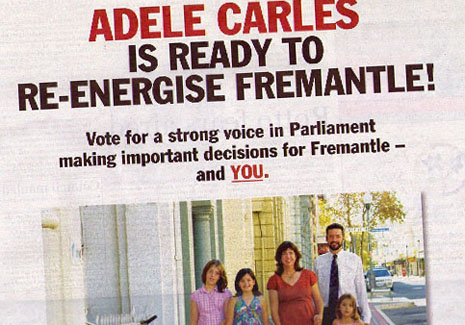
SOME COMMENTATORS see the Greens victory in last Saturday’s Fremantle state by-election as an ominous sign for a Labor Party juggling the conflicting demands of its inner urban and outer suburban support bases. This may be so, but several caveats need to be borne in mind.
In its candidate selection, Western Australian Labor seemed to exceed even the usual level of ineptitude the party brings to the task. Conventionally, a local government–based candidate represents good value, even if party membership is bestowed at the eleventh hour. In this case, however, the mayor in question not only lacked an obvious progressive political identity, but struggled to repudiate allegations that his pedigree was, in fact, anti-Labor. Piled onto this was his mayoral identification with pro-development elements in the local area: anathema to Labor’s substantial anti-development base in a seat such as Fremantle, and manna from heaven for the Greens.
Just as there are now some state and federal seats where the electoral contest is effectively between the Coalition (usually the National Party) and high-profile (usually conservative) independents, there is a clutch of seats where the contest is effectively moving towards Labor versus Greens. Fremantle follows the federal seat of Cunningham, where a “safe” Labor seat was lost to the Greens in 2002. Interestingly, Labor was in opposition in both instances, and party optimists will point out that Cunningham reverted to Labor status at the ensuing federal election.
Leaving aside by-election idiosyncrasies and dubious candidate selection, what are the broader implications for the Labor versus Greens struggle? Clearly, there is a political dynamic at play here that, when simplified, pits an educated, environmentally conscious element, whose votes alternate between Labor and the Greens, against a pro-jobs, pro-development constituency whose votes alternate between Labor and Liberal.
In inner suburban seats like Fremantle, this is a no-contest. Unlike the Greens, though, Labor has to assemble a state or national majority in order to govern. Hence, a strategy that can deliver seats like Fremantle may prove counter-productive in marginal outer suburban seats where voters may resent being lectured by inner urban elites about sacrificing their four-wheel drives and plasma TVs for some greater good.
At the federal level, Labor’s task is complicated because it’s in government, confronting the inevitable policy compromises which are poison to its green-tinged supporters. By opting for a more graduated, measured approach on climate change, Labor runs the obvious risk of driving its hardcore environmentalist supporters into the embrace of Green candidates supporting environmental purity (although no such stampede has yet been detected in national polling). And, while these votes probably return as second preferences in outer suburban lower house seats, the scenario is more complex in multi-member upper house contests and in inner suburban lower house seats.
In the Senate, disgruntled Labor supporters can help elect Greens senators, a phenomenon which has been evident for some time now. From a Labor point of view, this is regrettable, but Greens senators are at least (broadly) ideologically onside and (1975 notwithstanding) senators don’t decide who governs.
In the 2007 federal election, there was one seat, Melbourne, where the ultimate contest (after preferences) was between Labor and the Greens. In another four seats, Labor polled less than 50 per cent of first preferences and the Greens polled over 10 per cent. In each case, the Liberal primary vote was under 40 per cent, but only in the seat of Sydney was it low enough for the Greens to almost finish second.
In the 2006 Victorian election, the two-party preferred contest was between Labor and the Greens in three lower house seats. Each could be viewed as vulnerable if there is sufficient disillusionment with a (now) long-term Labor government, especially with development issues potentially aiding the Greens’ cause. In two of the three cases, the margins were close, and one suspects that the sitting members (both ministers) may have taken more than a passing interest in the Fremantle outcome.
In 2007, there were two such seats in New South Wales, but, come the 2011 state election, losses to the Greens will probably be the least of Labor’s worries.
Ironically, Labor’s fate in this scenario is to a great extent in the hands of its Liberal opponents. Obviously, the absence of a Liberal candidate in Fremantle was by-election specific, and unlikely to be replicated at any general election. While high strategy might justify a non-contest, arguments about party morale and boosting the upper house vote usually prevail. Hence, the Liberals need candidates who are either pretty awful and/or run dead, thus finishing third and allowing their preferences to defeat Labor. That said, it remains the case that a proportion of Liberal voters will not follow a card which preferences the Greens over Labor, being more concerned about policy and ideology than with the strategic value of dividing the progressive side of politics.
In summary, local factors seem to have been decisive in the Fremantle result and the federal implications seem limited. But for a couple of ministers in Victoria the outcome may have served to remind them of their parlous hold on their Green-trending electorates. •

Paul Rodan is an adjunct research associate in the School of Political and Social Inquiry at Monash University


3 Comments
“Labor’s fate in this scenario is to a great extent in the hands of its Liberal opponents”? I think not!
This is not really the case when you look at what has been occurring in Local Government elections to date (particularly in NSW), and more recently in State Government elections (i.e. Fremantle).
For example, in 1999, 1 Greens councillor was elected in Leichhardt (in Sydney’s inner west). This increased to 3 in the following local government elections, to 4 in 2004 (where each elected candidate won the highest number of votes in their respective ward), to 6 in 2008, when the Greens gained a majority on the council on a primary vote that was higher than the combined Labor and Liberal primary vote.
Similarly, the number of Greens councillors elected has been increasing steadily in other Sydney metropolitan councils including Marrickville (now 5), Waverley (3), Woollahra (3), Ashfield (3), as well as rural councils including Byron Shire (now 4), Blue Mountains (3) and Orange (2).
Currently the Greens are in second position (on two-party preferences) in several NSW and Victorian State electorates. The following Labor MPs at risk of losing their seats even with even a moderate swing to the Greens:
- Bronwyn Pike (ALP, Melbourne, Vic – 2%),
- Carlo Carli (ALP, Brunswick, Vic – 3.6%)
- Richard Wynne (ALP, Richmond, Vic – 3.6%)
- Verity Firth (ALP, Balmain, NSW – 3.7%)
- Carmel Tebbutt (ALP, Marrickville, NSW – 7.4%)
- Fiona Richardson (ALP, Northcote, Vic – 8.5%)
The Greens have also polled ahead of Labor in a number of NSW State seats currently held by the Liberal party:
- Vaucluse, NSW (8319 to Labor’s 7992)
- North Shore, NSW (7553 to Labors’ 7523)
This indicates that people in inner suburban areas of capital cities (and rural regions) are sick and tired of the status quo taking them for granted. They are becoming more and more disillusioned with the broken promises of both the Labor and Liberal parties, together with their links to developers and other vested interests (i.e. donations for development).
These people will increasingly vote for any party (or independent candidate) who will not ride roughshed over the interests of their local communities.
As a local observer, talk of Labor’s “ineptitude” in preselecting Tagliaferri doesn’t impress me much – I have yet to see a single such observer suggest what they should have done instead. Back the local bloke from the MUA, like they would have done if it had been left to the branches? Remember that 30 per cent of people in Fremantle vote Liberal under normal circumstances, and it doesn’t take much imagination to work out how they would have reacted: core Liberal vote plus core Greens vote plus Adele Carles’ personal following equals well over 50 per cent. Back a union figure like Dave Kelly from the LHMWU? None of them wanted it, because they had seen Labor’s research and knew what would happen.
Labor didn’t back Tagliaferri because they were inept, they backed him because they had done polling which showed support from Liberals would make him competitive, and they had no chance without him. However, they hadn’t reckoned on the force of the campaign waged against him by his local enemies. Perhaps they should have, but that still leaves unanswered the question of what they should have done instead. Under any of the other scenarios, we’d still be hearing Labor’s ineptitude, but for slightly different reasons.
I apologise for my oversight in omitting Brunswick from the list of Greens-vulnerable ALP state seats in Victoria. That said, I am unpersuaded that these seats could fall to the Greens without Liberal preferences (ie that the Greens could secure an absolute majority of primary votes or get across the line with help from smaller players). In 2006, the highest Greens primary vote in the four relevant seats (I’m including Northcote because it was an notional ALP/Greens 2PP finish, even though Labor secured an absolute majority on first preferences) was 29.71 per cent – in Brunswick; in no seats did they head Labor on primaries. The idea that Green candidates can make up twenty per cent plus in primaries at the next election seems too much for my cautious mind. Even beating Labor on primaries seems a big ask. I remain of the view that if and when the Greens break through in the Victorian lower house, it will be via Liberal preferences.
As for NSW, with optional preferences and a likely change of government, I’ll take the coward’s way out and concede that anything is possible.
I am also doubtful that one can extrapolate too much from Greens primary vote success in local government (smaller constituencies, often single issues) to state elections, and still less to federal. There is also the necessary caution about by-election success being maintained at the subsequent general election- see reference to Cunningham in my piece.
However, let me make clear that I certainly believe that three Victorian state Labor seats are vulnerable! Maybe even four, add Northcote?
On Fremantle pre-selection, if it is the case that Labor was effectively reduced to choosing between a union hack and a person who could be depicted as a closet Liberal, then the party’s sad state requires no further comment from me. On the other hand, the party managed to secure a high quality candidate for the federal seat, so the cupboard can’t be entirely bare, can it?