AFP Photo/ Torsten Blackwood
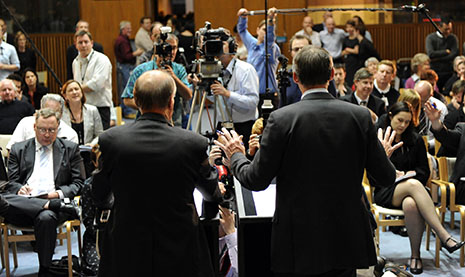
Even before election day the signs were that the news media were struggling to interpret national politics in a way that captured the interest of readers and viewers and enhanced the democratic process. Meanwhile, neither of the major parties was making a convincing pitch for a majority of votes. But it was the hung parliament that threw the spotlight most brightly on the shortcomings of the political and media establishment, raising important questions about how politics and policy are practised and reported in this country.
In this podcast Peter Clarke talks to political scientist Brian Costar and Sophie Black, editor of the online news and current affairs site, Crikey, about what happened and where we might be heading from here.
Inside Story podcast (29 mins 20 secs)
Peter Clarke is a Melbourne-based broadcaster, writer and educator who teaches at RMIT and Swinburne universities. He pioneered national talkback on Australian radio as the inaugural presenter of Offspring (now Life Matters) on ABC Radio National. Podcast theme created by Ivan Clarke, Pang Productions.


2 Comments
Congratulations on an insightful (if short) podcast on issues arising from the recent election. I’d like to make the following comments on some of the topics covered.
On the lack of policy manifestos. If the major parties cannot communicate coherent manifestos then surely it is for the media to then turn to the policies published on their websites and critique them. In the absence of a narrative (which would provide a framework for policy manifestos in various areas of responsibility), the media may have a roll to play in ‘assisting’ the parties in putting the pieces together.
On the notion of journalists as ‘players’ – Even if journalists are tweeting on stories they are working on and theories they hold those tweets and whatever other activities take place on social media will never substitute for actual analysis. The public doesn’t need pieces on political personalities and comments from sensationalist exponents of opposed viewpoints. We all have opinions about the moving images on 24 hour news channels and free to air television. The public want detail, not the mind-numbing highly-granular detail contained in Productivity Commission reports or Auditor-General findings but rather stories that thoughtfully translate those documents tabled in parliaments and published on websites into interesting arguments that stimulate critical thought.
On Gillard. Perhaps the PM does have depth but we still don’t know where she wants to take the country. The PM nominates education and health as areas she is passionate about and has taken hard and unpopular decisions about. Leaving aside the question of how difficult it is to beat up on your own base given that they have nowhere to turn; is that enough for a leader? Keating and Hawke are often cited as examples of leaders that had an idea of where they wished to take the country. Howard also had a vision for the polity. Where is Gillards?
On the symbiosis between politicians and the media – Those above 40 may not be able to envision a way of breaking the linkage but if the shallow commentary and breathless analysis of the latest poll continues, people will increasingly turn to unpaid and non-professional commentators for news. Indeed the impact of a Canberran public servant using a medium limited to 140 word missives having an oft-cited impact on a fundamental topic of media responsibility in reporting elections is the outlier of the trend.
If commercial media want to save themselves they are at some point going to have provide a product which is unobtainable elsewhere which is to say unique analysis born of engagement with decision-makers coupled with background research. Yes the research takes time and it is an open question whether for-profit organisations are the appropriate medium in which that can take place but the alternative is before our eyes. Shallow opinion pieces masquerading as hard news. Hardly appealing to those seeking to inform themselves.
“They voted for a tie”, “We didn’t get a result this time because that was what was deserved”: How many more times will we have to hear that before the media and commentators will realise it’s not true! Only NSW and the NT were ambivalent. Victoria, SA, Tasmania and the ACT were clear or very clear that they wanted a Labor government; Qld and WA were equally clear that they wanted.
The result of this election was unusual, but it was because of how polarising it was by state. I think it’s possible that the media and politicians don’t want to talk about that too much, lest it result in a fracturing of our national identity. I don’t think that’s a risk at all. Quite the opposite; the current attempt to deny its an issue will mean the problems which have caused it won’t be flesh-out, they’ll be entrenched.
The easiest explanation in the world is that the mining states didn’t like the mining tax, and the non-mining states did. Well, maybe that’s true, why hasn’t Mr Abbot tried to make sure the non-mining states understand from the perspective of ordinary people in Qld and WA why the mining state is (if it is) a bad idea? Why wasn’t Ms Gillard trying to explain at a human, connected level, why it’s a good idea?