TWO NAMES have been doing the rounds as the global newspaper business casts around for knights in shining armour to save them from an uncertain future.
The first is Alexander Lebedev, the former KGB agent who recently bought London’s Evening Standard newspaper from the Daily Mail & General Trust for the princely sum of £1 and who is now reported to be sniffing around the faltering Independent and Independent on Sunday, whose owner, Tony O’Reilly’s Independent News and Media, is in deep financial trouble.
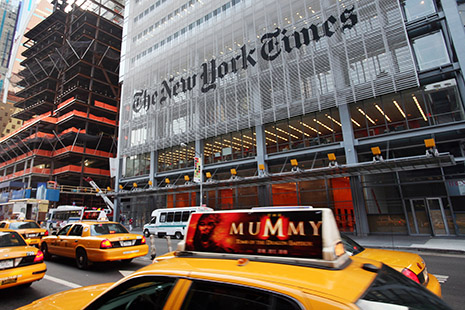
The other is Mexican mogul, Carlos Slim, who – according to the Wall Street Journal – agreed to inject US$250m into the New York Times in a deal that could see him emerge with 18 per cent of the company’s shares, making his holding second only to the Ochs–Sulzberger family, the paper’s historical owners.
Over the years the Sulzberger family has always been the biggest shareholder in the “Grey Lady.” The family’s voting stock will ensure that it retains control of the company, but there is speculation that a determined assault led by Slim may put pressure on the voting structure and force the Sulzberger family to relinquish control.
Slim, by the way, made his money by pretty much owning Mexico’s entire telephone system, both landlines and mobile phones. This gives him slightly more of a media background than Lebedev, whose experience of newsprint appears to be limited to his days as a spook at the Russian embassy in London when, by all accounts, he used to scan the Evening Standard for tidbits of intelligence to send back to his paymasters in Moscow.
But it was Lebedev who made the remark that cheered the hearts of every British journalist currently considering a change of career in the face of withering job cuts: “As far as I’m concerned this has nothing to do with making money. There are lots of other ways. This is a good way to waste money,” he told the Guardian.
There’s a certain degree of nostalgia at the moment for the days when pretty much all newspapers were owned by moguls and their families – or, like the Guardian in London and the St Petersburg Times in Florida, were owned by a non-profit trust.
The recent deals have prompted speculation that newspaper groups may be moving back towards private hands as private equity groups and institutional investors look for a way out. “The likely prognosis is that we will see more private deals and a withdrawal of the institutional and private-equity investors who have tried hard to milk the newspaper industry, but have done little to enhance the value or importance of newspapers,” Jim Chisholm, a newspaper consultant at iMedia Advisory Services, told the Sunday Times last week.
Newspaper companies – runs an argument that is gaining more and more currency of late – are better off if they are owned, or at least controlled, by private individuals or companies rather than the stock market. The reasoning is this: media companies (only a very few organisations now own only newspapers) that are controlled by shareholders do not have the journalism as their first priority but are limited to short-term, quarter-by-quarter management driven by the balance sheet. The main argument in favour of public ownership of news companies, on the other hand, is that they impose discipline and provide the means to raise capital to finance acquisitions.
Before examining these two arguments further, let’s get one thing out in the open. Whether privately held or publicly traded, a lot of newspapers, particularly in the mature print markets such as the United States, Europe and Australia, are in trouble. As if the disruption to audiences prompted by the rise and rise of the internet were not enough, the industry is being further starved of advertising revenue by the general global downturn. Profits, which rarely fell below 15 to 25 per cent a year, are plummeting into single figures and below as revenue dries up. Many companies are loaded with debt that is getting increasingly difficult to service. It is, as ABC managing director Mark Scott noted in a speech last year, a “perfect storm.”
But this is not a cyclical matter, as the digital director of Guardian News and Media, Emily Bell, noted in a speech to the Britain’s Polis think-tank last year. It is a structural shift. People are increasingly getting their news elsewhere and, when it returns, advertising revenue may well not head back into the coffers of news organisations. Advertisers park their dollars where people park their eyes, so the beneficiaries of any upturn in advertising may just as easily be social networking sites such as MySpace and Facebook as your local newspaper company.
But for the purpose of this argument let’s be more optimistic and examine some of the more upbeat scenarios. Mark Potts, co-founder of WashingtonPost.com and a former journalist with the Post and the Chicago Tribune, writes the influential blog Recovering Journalist, in which he has attempted to model the financial prospects of the newspaper business out as far as 2020. Potts sees revenues falling to a nadir by next year and bumping along the bottom until about 2014, at which point a gradual recovery is likely to kick in. Print revenues, he believes, will continue to fall – there is nothing he can see that will reverse this trend.
But Potts believes that online revenue, which was rising on average by about 20 per cent a year, albeit from a very low base, will overtake print revenues by 2018. The challenge for newspapers is how they are going to make sure they attract the lion’s share of that revenue.
Here’s the point. At the rate of attrition in first-world newspaper markets – in the United States, 15,000 journalists lost their jobs last year alone – by the time advertising revenue really starts to flow back and businesses start looking around for the right homes for their message, newspapers might not be the best place to settle. Put simply, they may not be able to fill the indispensable role and build the sorts of communities of readers that make them attractive to advertisers.
THIS IS THE CHALLENGE facing newspaper managers – how to remain a part of people’s lives into the future. It is not a challenge for the fainthearted and certainly not one that will be won by the short-term, cost-cutting strategies we have seen in the United States, Britain and – sad to say – some of our own media companies here in Australia.
Philip Meyer, veteran journalist, editor and educator and the author of the industry bible, The Vanishing Newspaper, has demonstrated a firm link between quality and influence and between influence and profitability. “A newspaper… produces two kinds of influence: societal influence, which is not for sale, and commercial influence, or influence on the consumer’s decision to buy, which is for sale,” he wrote in the Newspaper Research Journal. “The beauty of this model is that it provides economic justification for excellence in journalism. This is true because a news medium’s societal influence enhances its commercial influence. An influential newspaper will have more readers, be more trusted by those readers, and be worth more to advertisers.”
Meyer points to the current trend for raising cover prices and cutting costs – thus lowering quality – and calls it “harvesting market position,” a one-time only strategy aimed at making as much money as possible in the short-term. This strategy rests on the fact that brand loyalty will continue to attract readers for a while before they realise they are not getting what they want from their newspaper. But once they are gone, they rarely come back.
Thus far, newspaper circulation in Australia has not shown the rapid decline it has in the United States and Britain. There are a number of reasons for this: we are a little behind the curve in our consumption of online products due to our broadband internet services being relatively slow and expensive, for example. But this country is fast catching up.
The metropolitan press in this country is dominated by two big companies, Fairfax Media and News Ltd. Of the two, the Fairfax mastheads have probably enjoyed the greater societal influence as a result of 150 years of quality journalism. News Ltd’s mastheads, while also of a high quality, simply didn’t enjoy the same dominance of their target demographic as the Sydney Morning Herald and the Age once did in New South Wales and Victoria.
Fairfax has recently gone through a serious upheaval, both in the boardroom and on the editorial floor. David Kirk, who was attempting to drive radical change mostly with cost-cutting, was ousted in December in favour of his number two, Brian McCarthy, who came to Fairfax when it merged with Rural Press. Before he went, as he attempted an ill-fated public campaign to justify the cuts, Kirk pointed to what many analysts consider to be Fairfax’s major Achilles heel: the fact that its capital structure doesn’t separate voting shares from ordinary shares in the way that benefits companies such as the New York Times Company, the Washington Post Company and News Corporation.
Thus, decisions are largely dictated by the market rather than any individual who may either have a commitment to quality over profit or, as many analysts believe to be the case with the likes of Rupert Murdoch, a longer-term outlook and lifelong love of newspapers.
In their influential study, Taking Stock: Journalism and the Publicly Traded Newspaper Company, Gibert Cranberg, Randall Belancon and John Solosoky argued that often the decisions made in the boardroom of publicly traded newspaper companies are largely dictated by the opinions of media analysts in the financial sector “whose interests are strictly financial and whose expectations are by definition short term because of easy access to alternative investments at a moment’s notice.”
Writing in 2001, before the upheaval in the US newspaper market had really begun to bite, the authors drew on interviews with a selection of analysts, almost all of whom said that public ownership of newspaper companies was probably not good for journalism, whether it was good for the shareholders or not. “The stock market is concerned about growth rate, not about quality. The market doesn’t care,” said one analyst, while another said that if the cost of quality was perceived by shareholders to be too high, they would get “pissed.”
On balance, going public has been bad for journalism because of worry about the bottom line, the study concludes: “Going public forces management to tighten the belt, ‘to come out of the ivory tower,’ to invest less in editorial. Staffs are leaner and there is less investigative reporting. The quality of newspapers has degraded and part of that is due to going public.”
Their views are shared by analysts in this country and, if anything, that view is more pronounced in this economic environment. One media analyst, who wished to remain anonymous, told me last week: “The problem with media companies is that profitability is pretty important if you are publicly traded – too often it is more important than the journalism itself.
“When you look at what is happening at the moment the traditional media companies are in panic mode because of what is happening in the cyclical environment – they are being forced to cut costs to manage their margins, but the problem we have is that they are cutting the most important things – the content creators. So they cut staff, which then directly affects the quality and hastens the downward movement in circulation because more and more people start to look elsewhere and the advertisers don’t value them as highly.”
In his most recent update, media analyst Christian Guerra of Goldman Sachs JB Were wrote that the cost-cutting strategy was “driving decay in content quality” and added that “this must harm audiences”.
“The question we do not know the answer to is: Are audiences noticing the decay in quality? If the answer to this question is ‘Yes,’ which we suspect it is, traditional media companies face the prospect of the current challenges (cyclical and structural) actually driving further audience migration away from traditional media,” he wrote, adding: “It is ironic that traditional media companies may be contributing to their own demise.”
To add to this awful irony, it appears likely that – because of their very structure – there is little publicly traded media companies can do to arrest this. They are merely doing what the market forces them to do. In Guerra’s words, they are “attacking the one lever in their control: operating costs.”
So, if the value of media stocks continues to race to the bottom we may well see the return of the media mogul. Whether this will be good or bad for journalism is another matter. Remember – media moguls have priorities too.