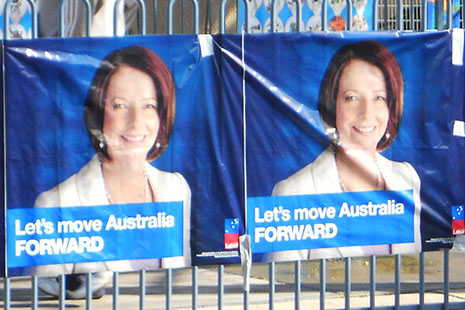
HOW DID it come to this? The Labor government survives, but only as a minority. After a smashing election victory, two years of riding high in the polls and a long period of stratospheric approval ratings for Kevin Rudd, 2010 saw a slide in popularity, a leadership coup, the rush to an election, and a result much more disastrous than anyone foresaw. It is one of the most spectacular political collapses in Australian history.
The decline dates back to well before the election: the unravelling of the politics of climate change and the government’s surrender on the issue; the failure to deliver on some key promises; the conflict over the mining tax; controversies over government waste and mismanagement; and – for whatever mix of reasons – an increasingly heavy focus in the media on the government’s problems to the exclusion of its achievements.
Even taking all this into account, though, Labor did badly in the campaign. According to most polls it started ahead, but that lead evaporated to produce what was essentially a dead heat on election day.
Labor’s conduct of the campaign has come under telling and persuasive criticism from many quarters. Among the defeated Labor candidates, Allanah MacTiernan’s view was that, “We lost our nerve, got rattled, and instead of going out and aggressively selling our good story we focused on trying to scare people,” while for Maxine McKew, “You have to be seen as a credible government and have clarity on what you stand for, and we suffered on both fronts.”
Press gallery commentators concurred. Bernard Keane concluded that Julia Gillard “arrives as prime minister in her own right a diminished figure, one humbled by a disastrous campaign that nearly cost Labor office.” Michelle Grattan thought that Labor’s campaign was “at times fairly strange or transparently expedient” and that “Labor has given the Coalition so many opportunities in this campaign that Abbott is like the man who has to be careful not to over-indulge on the cream cakes.”
Labor stalwarts, especially those estranged from a power structure controlled by the NSW Right, also agreed. The former NSW premier Morris Iemma, who blames this group for his ousting, said that if national party secretary Karl Bitar had a conscience he would resign, and called the campaign the most inept in living memory. Labor’s long-time pollster and veteran of many campaigns, Rod Cameron, called it “the worst federal campaign I’ve ever seen. The fact that Labor just snuck into government is an absolute disgrace.”
The process of shaping what becomes the accepted explanation for a political victory or defeat can be contentious. In this case, the much-predicted Labor bloodbath is unlikely to occur because all the key players are constrained by the need to maintain unity in the face of their parlous political situation. It is much more than an academic debate: the stakes include current career prospects – especially the influence of the NSW Right and, specifically, the future of national secretary Karl Bitar – and the assumptions that feed into planning for future campaigns.
Immediately after the election, the Age reported, “a senior Labor source said national secretary Karl Bitar, who helped oust Mr Rudd, had been briefing party figures to use the ‘line’ that the defeat had been the result of leaks from the Rudd camp.” Moving pre-emptively, Bitar’s ally, former NSW power broker Graham Richardson was blaming the leaks even as voters began casting their ballots on election day. While this conveniently narrow explanation has a core of truth – the leaks were very damaging – it is ridiculously partial, ignoring the six central failures of Labor’s campaign.
1. An inability to exorcise or channel the ghost of Rudd
The plotters who managed to oust Kevin Rudd from the prime ministership no doubt prided themselves on the speed, efficiency and neatness of their coup. But they seem to have paid no attention to its aftermath. Did they imagine that from the moment of his defeat Kevin Rudd would become an irrelevance, that they could both publicly and privately demean his contribution and that the whole country would move forward as they wished, forgetting everything that had happened pre-Julia? Their assumption of mass amnesia, of instant public acceptance, would have been unrealistic in any situation, but the idea that calling an election would make everyone lose interest in Rudd was fanciful.
For the Sun-Herald’s Paul Daley, “The thing that perplexes many who have watched, known and admired Gillard the politician and the person for many years is: why? … The errors of her first three weeks in the job and during the subsequent first four weeks of the election campaign stem, I believe, from one thing: her undue haste to run to the polls in the hope that an election would overshadow the means by which she became PM. She should have waited. Instead she bolted. It was a classic political sleight of hand – look at me now, not then. The problem is, we’re all smarter than that.”
Instead of Rudd disappearing, “every day it’s more about Kevin,” wrote the Australian’s Paul Kelly put it in the middle of the campaign. Of course, this was partly due to the leaks in week two, which were unprecedented in an election campaign and widely blamed on Rudd or his supporters. But there was also widespread media and public interest in how Rudd would behave, and it was only heightened by his enforced silence during his gall bladder operation. And, of course, the Liberals kept raising his spectre.
When he did appear, the interest was obsessive. Veteran journalist, Laurie Oakes, commended his re-emergence: “[W]e had to wait until the mid-point for one of the participants to look prime ministerial. And when it happened it was neither party leader… It was Kevin Rudd, emerging from gall bladder surgery, who showed them how.” But the long awaited public meeting between Rudd and Gillard was a tortured disaster: “There’s real forgiveness and then there’s Kevin Rudd’s kind of forgiveness – the one that looked exactly like revenge at the weekend…” wrote the Herald Sun’s Sally Morrell. “He didn’t even deign to make eye contact much as she tried desperately to engage the man sitting next to her. It was devastating footage and it led the TV news all night.”
Although we cannot make a causal link with certainty, it is notable that Labor’s biggest losses were in constituencies for which Rudd had a special appeal. The first and most obvious was Queensland. But there were other contributors to the result in that state, include the unpopularity of the Bligh government and the fact that the mining tax was particularly unpopular in Queensland (and in Western Australia). Perhaps the losses would have been as big with Rudd still leader. We can never know.
The other group that might have held Rudd in special regard has not been much commented on and I do not know of quantitative data to support a link. But some observers, including Maxine McKew, think that Labor’s losses were particularly heavy in Asian communities. Rudd, a Mandarin speaker with a Chinese son-in-law, had appealed greatly to this group, and with their traditional respect for leaders they might have been particularly affronted by his overthrow. “Across the suburbs the worst booths for the Labor Party were frequently those suburbs with high migrant percentages, particularly Chinese, Korean and Vietnamese voters,” reported the Sydney Morning Herald’s Andrew Stephenson.
2. A government afraid of its own record
If the first lesson of the campaign is that defeated leaders do not disappear once their existence becomes inconvenient, the coup had another consequence the plotters do not seem to have anticipated. Deposing your leader means you are disowning your own record, at least to some extent. The leadership coup, wrote Paul Kelly, “saddled Gillard with a terrible contradiction: having condemned Rudd Labor’s record, she had to justify that record for her own election.”
Again, this was exacerbated by Gillard’s rush to the polls. According to Oakes, “Rudd had intended to go to the polls in October. It is clear, in retrospect, that Gillard should have adopted the same timetable. If voters had been given a couple of months to get used to her in the top job, she would have gone into the campaign with at least some of the gravitas of an incumbent PM. Instead the election has often seemed a contest featuring not one but two opposition leaders.”
A common ploy of spin doctors having trouble winning the argument is to change the subject. It was a strategy the Rudd–Gillard governments practised with irksome frequency. But Labor needs to learn that when governments run away from fights, they are Darius, not the Swamp Fox. During the American War of Independence, the Swamp Fox was a guerrilla fighter who would engage the British briefly and then fade away to fight another day. This – choosing when and how you confront an enemy with superior conventional power – is an essential of guerrilla warfare. But while governments have great capacities to create diversions and focus the public agenda, they cannot forever run away from fights. Otherwise they seem more like Darius, the king of the Persians, whom Alexander the Great knew he had beaten once he saw him retreating. Labor “has run from every fight,” wrote the political scientist Lindy Edwards. “Rather than stand its ground, it has backed down, giving the impression Abbott’s accusations were true.”
Neil Lawrence, who masterminded the Kevin07 campaign but then fell out with the new national office of Karl Bitar, seemed to have a deeper grasp of the strategic needs than anyone still inside the Labor camp. He noted that the national mood, in contrast to 2007, was for stability, and after noting how many of the ads on both sides were negative, thought that the party with the more positive message would win.
In all election campaigns parties have a mix of positive and negative – why you should vote for us and why you shouldn’t vote for them. But in 2010, the negatives predominated even more than usual. Abbott ran almost entirely on a list of the Labor negatives he would expunge, and Labor ran on the fear of Abbott – sending out the message that it had few positives to boast about.
3. Reneging on the three debates
There is a conventional wisdom, in my view outdated, that debates are bad for incumbents and good for challengers because, by putting both leaders on the same level, they elevate the challenger. But in federal election campaigns both leaders receive saturation media coverage, so that argument is less relevant. Debates, in my view, offer an advantage to the better debater, and if the wormology offered by the last several televised debates teaches us anything, it is that the leader with the most positive messages scores best.
Kevin Rudd promised in 2007 that there would be three debates in the 2010 campaign, although he later prevaricated about whether the health debate he had with Tony Abbott earlier this year constituted one of these three. Gillard reneged on the promise. She won the debate at the end of the first week of the campaign, although most observers thought it a rather dreary occasion. Then, as the campaign proceeded, Labor became more desperate, and was keen to debate Abbott on the economy. The to-ing and fro-ing over whether the leaders would have a second debate might have helped Labor very slightly – though it also showed its desperation – but it was also another ingredient in the general tone of sterility that ran through the campaign.
Partly as a substitute, both leaders participated in community forums. Among these, and the speeches to the National Press Club, the party campaign launches and the debate, the only occasion on which Abbott clearly out-performed Gillard was the first community forum at Rooty Hill. He was helped by the fact that he appeared second: having had a chance to see how remote Gillard looked sitting on the stage, he opted to stand on the same level as the audience. This advantage for Abbott was neutralised at the second community forum when both leaders stood at audience level.
Three formal debates would have exposed Abbott’s lack of positive policy content and his limited grasp of detail. It would have given Gillard the opportunity to showcase the positive aspects of the government’s record in a way that was otherwise more difficult. It was typical of Labor that it threw away this potential advantage in the name of clever campaigning.
4. Gillard’s quick fix fixation
When Gillard became leader there was a flurry of activity designed to address Labor’s perceived political vulnerabilities. A deal was struck on the mining tax. The announcement of an off-shore processing facility in East Timor gave the appearance of action on boat people. And more attempted quick fixes would follow during the election campaign. Each was partially effective, but each also came unstuck to varying degrees.
The mining tax was largely neutralised as a live issue during the campaign. But Labor had deliberately misled the public on the scale of its retreat by changing the assumptions in the revenue modelling, and inevitably this trickery became public. Moreover, although Labor had taken the heat out of the issue and getting some kudos for talking directly with the biggest mining companies, a large part of the constituency that opposed any tax increase remained unreconciled.
Labor was caught in a bind by the hysteria surrounding boat people. As part of the attempt to defuse the issue, it sought to reintroduce the kind of offshore processing that the Howard Government had carried out on Nauru, and made the dramatic announcement that it would do so in East Timor. Unfortunately for Labor, this agreement was soon thrown into doubt by the East Timorese parliament, and so it remained an issue through the campaign. Abbott used asylum seekers as a centrepiece of his campaign, promising to phone the prime minister of Nauru the day after the Coalition took office, and to keep in personal touch with navy boats off northwestern Australia. The lesson: it is probably impossible for Labor to outbid the Liberals in an auction on xenophobic policies.
Labor was caught in a bind of its own making on global warming. It had alienated many of its supporters with its surrender on the issue, but at the same time was afraid of a scare campaign by the Liberals if it did anything that involved any cost to anyone. But it was not clear it could go for five weeks without saying anything at all about the issue. The “solution” – apart from promising there would be no carbon tax in the coming term – was to announce a citizens’ assembly to discuss the issue. This was surreal Julia. Probably nothing Labor did in the campaign attracted greater ridicule.
During the campaign Gillard also announced a series of almost random measures, such as a plan to give top teachers annual bonus payments. The unintentional theme binding these disparate initiatives together – a theme that applies to both parties’ campaigns – is a shallowness of policy substance and a belief that fiddling with surface appearances will be sufficient to dispose of embarrassments.
5. The Epping–Parramatta rail link
There was one promise that seemed to epitomise Labor’s cynicism and its counter-productive political “feel” – the promise to build the Epping–Parramatta rail link in the suburbs of Sydney. In itself, the idea has merit. The problem is that it was first promised by a former NSW premier, Bob Carr, twelve years ago. When Gillard and the current premier, Kristina Kenneally, appeared together to make the announcement the effect was to tie federal Labor more closely to the political disaster that is the NSW Labor government. In electorates resentful of the lack of public transport it primed feelings of antagonism. No announcement could have more effectively embodied Labor’s lack of delivery on its promises.
In the following days, Labor’s cynicism was again on display. Information emerged that the decision had been rushed, that the bureaucracy knew little about it, and that it contradicted planning inside the state government. The most convincing testimony to its counter-productive contribution was the fact that the Liberals used the promise in their election material as evidence that Labor could not be trusted and did not deliver. Rarely, if at all, has one side’s promise featured directly in the other’s advertising.
6. Feeding Abbott’s momentum
Although many people expected an election-eve swing back towards the government, the Liberals finished the campaign with energy and momentum. After strong performances early in the week at the National Press Club and at the Brisbane community forum, and after a superhuman effort over the previous five weeks, Gillard ran out of steam in the last couple of days. She seemed tired, even irritable, and reduced to parroting a few key phrases over and over. In particular she charged that Abbott would reintroduce Work Choices – which by that stage was probably not considered a credible claim by many people. In contrast, although it was a fairly transparent gimmick, Abbott’s decision to stay awake and active for the thirty-six hours leading up to election day generated a lot of positive publicity, and especially good photos and TV footage.
The central axiom of the Labor campaign was simple: as the days went by and the public focused on the prospect of an Abbott government, swinging voters would turn back to Labor. They clearly underestimated some of Abbott’s appeal. As the public relations specialist Noel Turnbull wrote, both leaders “are really good on the campaign trail – engaging, real, humorous and sincere. This is an Abbott quality underestimated by those who see him muscling up on TV.”
With polls showing that a majority of respondents expected Labor to win, some party strategists began to worry that voters were not taking the prospect of an Abbott victory seriously enough. Their response was to leak internal polling showing that Labor was doing much worse than in the published polls (which, given the eventual result, throws their accuracy into question). The main impact of the leaks was to add to a narrative of a Labor decline and a Liberal surge. Perhaps they made some voters concentrate more on the negatives of a possible Liberal win, but even more they reinforced the image of a disintegrating government. Even this last desperate Labor tactic probably did more harm than good.
All of which means that the Labor Party’s promised inquiry into the conduct of its campaign will have a lot to consider. It was a spectacular collapse and a lucky escape. Labor’s problems were much deeper than the leaks of the second week and, significantly, many of their troubles arose when senior party figures made a calculation of what they thought was politically clever and turned out to be wrong. •