WHILE the federal opposition and the media pursue education minister Julia Gillard over school buildings and “political correctness” in the new national history curriculum, little attention is being given to a more serious issue: the long-term consequences of the government’s emphasis on standardised testing and “accountability” for schools and teachers. The Education Revolution is based on ideas that have already been tried, and have failed, in the United States.
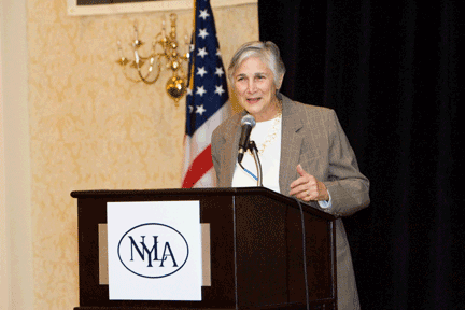
The debate about what standardised testing and school accountability actually do to education has been reignited in the United States by the publication of Diane Ravitch’s book, The Death and Life of the Great American School System: How Testing and Choice Are Undermining Education. Ravitch, a research professor of education at New York University, is a respected historian of education. She was also a proponent of the key ideas behind the Bush administration’s test-driven No Child Left Behind program.
After more than a decade committed to the idea of school accountability and advocating the very policies that the Rudd government has adopted, Ravitch looked at the facts, found that they had changed and changed her mind. In early March she set out some of the reasons for doing so in an article in the Wall Street Journal. “On our present course,” she wrote, “we are disrupting communities, dumbing down our schools, giving students false reports of their progress, and creating a private sector that will undermine public education without improving it. Most significantly, we are not producing a generation of students who are more knowledgeable, and better prepared for the responsibilities of citizenship.”
Ravitch began writing her new book in 2005–06. At that time she had no clear picture of the shape it would take. “I wanted to write about what I was observing in NYC [New York City] and also try to untangle and trace its origins,” she told me. “That took me to San Diego, and San Diego took me back to District 2 in NYC. The more I learned, the more I realised that this was a national story, involving a strong consensus around the joined ideas of choice and accountability. That was the setting for the book and provided the framework.”
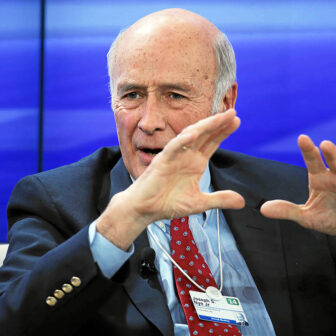
It’s particularly telling for the Australian debate on education that Ravitch's book started with concerns about what she was seeing in her home city of New York. Julia Gillard has been strongly influenced by the ideas and approach of Joel Klein, Chancellor of New York City Schools. In an address to the Brookings Institution in Washington in June 2009, she paid specific tribute to Klein. “I met Joel this time last year in New York and he gamely took up my invitation to visit Australia last November,” she said. “His role in our public and professional debate about transparency was important and influential. He achieved this impact because of the strength of his dedication to equity and excellence and the platform of positive change that he has built in one of the most demanding public school systems there could be.”
Several elements of Labor’s national program for education are copies of US initiatives. Teach for Australia is based on the Teach for America program; NAPLAN (the National Assessment Program – Literacy and Numeracy) and the My School website are based on programs introduced in New York by Klein; and in her Brookings speech Gillard mentioned plans for $50 million to be spent on leadership development for school principals “directly inspired by the leadership academy created by Joel in New York.”
For her part, Diane Ravitch is no Maoist education bureaucrat – she remains an educational traditionalist. Where she has broken ranks with the conservative side of the US policy debate is on the issues of school choice and school accountability through standardised testing. Both these policies, she says, have failed to deliver what she wants schools to deliver. “Because the law demanded progress only in reading and math, schools were incentivised to show gains only on those subjects. Hundreds of millions of dollars were invested in test-preparation materials. Meanwhile, there was no incentive to teach the arts, science, history, literature, geography, civics, foreign languages or physical education,” she wrote in the Wall Street Journal.
“In short,” she continued, “accountability turned into a nightmare for American schools, producing graduates who were drilled regularly on the basic skills but were often ignorant about almost everything else. Colleges continued to complain about the poor preparation of entering students, who not only had meagre knowledge of the world but still required remediation in basic skills. This was not my vision of good education.”
According to Ravitch, the evidence shows that No Child Left Behind has failed. “The testing regime that NCLB installed in every public school has not improved American education…” she wrote in another recent article. “NCLB requires that all students must be proficient in reading and math by 2014. When the legislation was signed in 2002, this goal was wildly unrealistic – and now, it is merely laughable. The target date is only four years away, but no state is remotely close to 100 per cent proficiency. Indeed, in 2008, 35,000 of the nation’s schools bore the stigma of ‘failing’ because they weren't making sufficient progress toward that utopian target. What NCLB has done with its proficiency deadline is set a timetable for the demolition of American public education.”
That’s a dire assessment of the effects of NCLB on education in the United States, and on the future of the US public school system, and it comes from a former proponent of that program. So perhaps we should be asking: are we at risk of repeating the same mistakes here in Australia?
If so, there’s no serious political opposition to doing so. Although the federal opposition and its friends in the media have made a great show of pursuing Julia Gillard on schools spending and the “political correctness” of the national history curriculum, there is bipartisan agreement on the fundamentals of education policy. NAPLAN is merely an augmentation of the national reading benchmark tests introduced by the Howard government in 1997. Labor’s national curricula continue, and build on, a Howard government initiative.
Despite all the “fork in the road” rhetoric leading up to the 2007 election, on education policy Labor is still following the Howard path. The opposition’s attacks on the details of Labor's education policy – the allegations of financial and intellectual mismanagement – hide this basic agreement. Set aside the history and culture wars and there is no difference between Labor’s education policy and the opposition’s education policy. Both the major parties’ policies are set on the same goals: the standardised testing, “parental choice” and school “accountability” that one of its principal American proponents has renounced. •