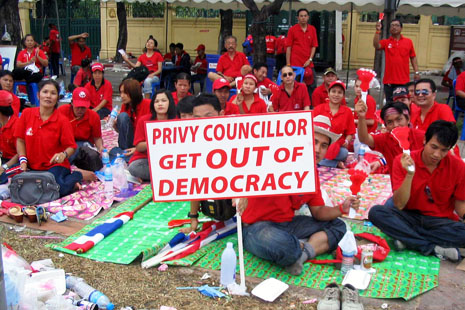
WHEN THAI PRIME MINISTER Abhisit Vejjajiva launched his crackdown on red-shirt protesters on Sunday night, one of his first acts was to post army units around Chitralada Palace, the Bangkok residence of Thailand’s king. It was a routine security measure but, in the current climate, it was an act rich in symbolism. No one imagines that the red-shirts posed any immediate threat to the security of the king, but Thailand’s supreme institution is being inexorably drawn into battles about who should legitimately run the country. As the political heat increases, the country is edging ever closer to open public debate about the political role of the monarchy.
The latest impetus has come from “phone-ins” by exiled former prime minister Thaksin Shinawatra, who was overthrown in the coup of September 2006. In a series of speeches that helped to galvanise his red-shirted supporters, Thaksin launched direct attacks on the king’s Privy Council. He specifically targeted Privy Council power-brokers Prem Tinsulanonda and Surayud Chulanont, accusing them of orchestrating the military coup against his former government. His brazen words transformed persistent rumour about high-level royalist plotting into front page news and motivated thousands of red-shirts to lay siege to the house of Privy Council President Prem, before descending on Pattaya to disrupt the East Asia Summit.
In the current turmoil, why do Prem and Surayud matter? They matter because they are two of the most influential men in Thailand, regarded as national statesmen and moral guardians. Prem is a former commander in chief of the Army and ruled as prime minister from 1980 until 1988, cementing his place as a favourite of the king with the defeat of the Communist Party of Thailand. Surayud, Prem’s protégé, went on to be supreme commander of the Royal Thai Armed Forces, and was appointed prime minister by the September 2006 coup makers. Both Prem and Surayud were unelected prime ministers; both have held top military command and both are now members of the king’s Privy Council. Thaksin’s direct attack on men of such status and authority represented a significant escalation in Thailand’s ongoing political conflict. But, most ominously, in attacking these prominent royal advisors Thaksin took a step closer to an attack on the monarchy itself. Thaksin’s fighting words gave the red-shirt campaign a republican tinge.
The nightmare for Prem, Surayud and others in the royalist elite is that decades of careful media management and ostentatious good works could start to unravel at a moment when the monarchy is facing an uncertain future. King Bhumibol Adulyadej is eighty-one and his health is fragile. Inevitably, even amidst the ongoing political chaos, his likely successor, Crown Prince Vajiralongkorn, is receiving extra scrutiny. The prince is an unpopular and divisive figure who has failed to tap into the reservoir of charisma and auspiciousness that his father has built up during his sixty-two year reign. Many feel that the king’s younger daughter, Princess Sirindhorn, would be a more appropriate heir. The privy councillors are naturally worried that the monarchy is being drawn into the political melee during a period of royal vulnerability and lingering uncertainty about the succession.
The last time the royal institution faced such a potentially hazardous set of circumstances was in 1932 when the absolute monarch, King Prajadhipok, was forced to accept constitutional constraint. In that decisive year, Thailand’s king was called to account by a group of non-royals who demanded that he relinquish total control. Back then, the modernising drive of former kings had left many in the Thai elite with a conviction that a more democratic government was required. The old feudal order was no longer appropriate; it would only be allowed to remain as a more minor part of the political landscape. Absolute rule had come to an end.
Over the years and decades that followed, an uneasy compromise was established between the people, the military and the palace. The military governments that held sway for so much of the twentieth century ultimately saw the benefits of maintaining a highly respected royal figurehead. King Bhumibol, who ascended to the throne as a very young man in 1946, grew into a role that was cultivated for him by statesmen and power-brokers, men like Prem and Surayud. Successive governments which sought to foster national integration and economic development found it useful to deploy the monarch as a central unifying symbol. As Bhumibol grew into his role and consolidated his influence, he came to assume a supreme moral stature. He is now Thailand’s preeminent national figure and a powerful ally of every government that enjoys his favour.
Many have speculated that the Thaksin government did not enjoy such royal favour. Thaksin’s enemies accused him of undermining the position of the monarch. His CEO-style leadership, combined with unprecedented electoral support, presented a stark contrast with the ceremony, tradition and patronage of the palace. The king has long been regarded as a champion of Thailand’s poor through his well-funded and high-profile rural development projects. But Thaksin’s populist economic policies, which pumped money directly into every village in the country, dwarfed the king’s royal munificence.
For most Thais there was no inconsistency in supporting both Thaksin and the king. Thailand’s masses readily accepted that two styles of leadership and charity could exist side by side. After all, the popular Thai cosmos is full of all sorts of power and influence. Purists may lament the mix of spirit belief, Buddhism and consumerism that pervades Thai popular culture, but most Thais celebrate the varied ways in which power and potency can be expressed. In this culturally tolerant framework, Thaksin’s modernism could blend readily with royal traditionalism.
But Thailand’s elite is not so conceptually adroit. For them, a hardening of the categories of authority set in long ago. They see power as a zero-sum game. In their besieged world-view, mass electoral support for Thaksin, and his personal adoration among the country’s poor, threatened the pre-eminent symbolic power of royalty. Something had to be done. The coup of 19 September 2006 was their answer.
Thaksin has yet to reveal detailed evidence of how privy councillors Prem and Surayud plotted against him, but there is no doubt that the 2006 coup had a strong royalist flavour. The plotters decided to wrap yellow ribbons around the gun barrels of the tanks that rolled onto Bangkok’s streets and forced Thaksin out of office and into exile. Yellow is the colour of the king. The yellow ribbons were a clever short-term strategy for winning popular support in Bangkok, but the colour coding has now backfired badly. The image of royal support for the coup has done more than anything else to generate critical domestic and discussion about the way in which the power, charisma and symbolism of the palace is deployed to support authoritarian tendencies in modern Thai politics. The rapturous celebration of the king’s eightieth birthday in 2007 was not completely overshadowed by the coup and its aftermath, but increasing discussion of royal ambivalence about democracy was an unwelcome distraction at the party.
This critical discussion has been building for some time. In 2006, journalist Paul Handley published an unauthorised biography of Bhumibol, The King Never Smiles. This landmark exploration of the creation of royal imagery and the king’s entanglement in six decades of Thai political life paints an unflattering picture of a monarch who has consistently backed military intervention into the political sphere. The King Never Smiles is, without doubt, the most important book published on Thailand in the past decade, if not longer. It took a journalist to venture where academics feared to tread. Although it was banned in Thailand (by Thaksin himself) the book can readily be ordered from online bookshops, scanned chapters are available on the internet, and some parts have been subversively translated into Thai. Handley’s royal revelations generated an unprecedented flurry of Thai web-board chatter that continues to reverberate today.
Another small stepping stone towards frank discussion of the monarchy was the International Conference on Thai Studies held at Bangkok’s Thammasat University in January 2008. The conference was attended by over 600 academics, journalists and students from Thailand and overseas. There had been calls for an boycott of the royally sponsored conference in the wake of the royally sponsored coup. Instead, senior academics organised a series of presentations that examined the contemporary role of the monarchy. Scholars critically discussed royal business interests, the appropriateness of the king’s rural development theories and the extraordinary legal protections provided to the royal reputation. The best attended session was a panel discussion of Handley’s book. It would be academic narcissism to suggest that the conference was an important turning point in Thai public life, but it did provide some support and encouragement for those in Thailand who are working towards a more mature public discussion of royal power. It was a sufficiently important event to attract the attention of Thai Special Branch officers who were diligent observers in the most controversial sessions.
BUT IT HAS BEEN much less academic action that has prompted the most severe reaction and created the most negative publicity for Thailand’s king. In December 2006 a Swiss national, Oliver Jufer, was arrested in the northern city of Chiang Mai for defacing a poster of the royal family because he could not buy an alcoholic beverage on the king’s birthday. Jufer’s juvenile graffiti earned him a ten-year prison sentence under Thailand’s draconian lese majeste law. He received a royal pardon after spending only four months in prison but, in the meantime, the case generated a virulent wave of online material mocking the king. The Thai government responded by blocking the entire YouTube website. In August last year, Australian author Harry Nicolaides was arrested for writing a single paragraph about the Crown Prince in a self-published novel that sold only a handful of copies in Thailand. Nicolaides was sentenced to three years in prison but he too received a royal pardon after being locked up for six months. Nicolaides’ fate didn’t produce as much online vitriol as Jufer’s case but it increased disquiet about the use of the anachronistic law.
It is unfortunate, but inevitable, that lese majeste charges against foreigners generate the most media attention. As the political heat has steadily increased, the law has been used against dissident voices within Thailand. Two political activists who made anti-royal comments at political rallies have been locked up – one sentenced to six years, the other still awaiting trial. A warrant has been issued for the arrest of an academic from one of Thailand’s most prestigious universities who fled to England after being charged for writing about the role of the king in the 2006 coup. Most recently, in an instance of bizarre excess, a ten-year sentence was handed down to Suwicha Thakor for posting “digitally altered” images of the king. These cases of repression have prompted a call by over 100 academics for reform or abolition of the lese majeste law. In response, the Thai government has merely said that it will make sure the law is implemented properly. There have even been calls from within the government for harsher punishments. Royalist commentators have made the predictable charge that academics do not understand how deeply Thais revere their king.
One of the reasons why the current Thai government is reluctant to change the lese majeste law is because it is thoroughly indebted to royalist forces for bringing it to power. Last year royal yellow hit the streets of Bangkok again when the so-called People’s Alliance for Democracy campaigned for the overthrow of the pro-Thaksin government that had been elected in the post-coup election of December 2007. The “yellow-shirts” didn’t accept the result of that election and were determined to erase any vestiges of Thaksin’s influence from the political scene. They occupied Government House for three months, besieged the parliament, and then, in an act of supreme provocation, closed down Thailand’s airport for a week. Even though they called themselves the People’s Alliance for Democracy, or PAD, they argued that parliament should be predominantly appointed rather than elected. This anti-democratic campaign was waged unashamedly under the royal banner, with yellow shirts the uniform of choice and images of the king and the queen prominently displayed at their increasingly provocative rallies. “We will fight for the king” was their battle-cry. They claimed to be defending the monarchy against corrupt pro-Thaksin politicians.
The king himself chose to remain silent about the use of his royal brand in the yellow-shirts’ campaign. His silence could, perhaps, be justified by the old cliché that Thailand’s royals sit above politics. But the cliché was shattered when the queen appeared at the funeral of a PAD protestor, killed in a violent confrontation with police in early October 2008. With this single act, Queen Sirikit placed the monarchy’s immersion in politics on full public display and added force to the rumours that the yellow-shirted PAD had backing, and personal connections, at the highest level. The images of the queen standing shoulder to shoulder with political thugs who were trying to engineer the forcible overthrow of a democratically elected government were deeply disconcerting for many Thais.
Ultimately the pro-Thaksin government was removed from office. It was weakened by the relentless street campaign against it, discredited by the refusal of the military to enforce its emergency decrees or clear the airport occupation, and ultimately killed by a Constitutional Court ruling that dissolved the ruling party and expelled twenty-eight government members from the parliament. In December 2008 Abhisit Vejjajiva, the leader of the Democrat Party, was able to cobble together a parliamentary majority with the help of the defection of some of Thaksin’s former buddies.
Thaksin is in exile, his allies have been forced out of government, and the red-shirts now face the wrath of Thailand’s security apparatus. But Thaksin remains a potent political force in Thailand. His increasingly inflammatory “phone-ins” are tapping into feelings of anger towards the hitherto hidden forces that helped engineer the 2006 coup and the unelected rise to power of Prime Minister Abhisit. The explicit targets of his campaign are the two named privy councillors, but this is code for something much more significant. Although Thaksin has gone to considerable lengths to declare his unwavering loyalty to the king, he can now see political benefit in attacking royalist elitism, backroom power-broking and the way in which royal power – real and symbolic – has been used to undermine electoral mandates. The strategy has been instrumental in galvanising the red-shirts in their high-stakes campaign against Abhisit’s government. With Thaksin and his red-shirted masses on a collision course not just with the government, but also with the Privy Council, the “royal Institution” itself is now uncomfortably close to the heat of political battle.
When the smoke clears, there will, of course, be vigorous attempts to put the royal genie back into its gilded and apolitical bottle. Legal restrictions on royal commentary will be enforced with increasing gusto. Thais who dare speak up about the country’s political realities will face the risk of heavy legal sanctions. International commentators calling for free speech will be vilified as cultural imperialists seeking to impose western values on the loyal subjects of the Thai king. But these attempts to impose silence won’t work because each clamp-down on royal discussion generates yet another, more penetrating, round of debate, speculation and, in some cases, irreverence.
With or without Thaksin’s latest provocations, and whatever the ultimate fate of the red-shirts, the extraordinary events of the past few years mean that silence on Thailand’s monarchy is no longer a viable option. •
This analysis continues in Thailand’s royal sub-plot thickens