ONE PART OF my response to Dean Ashenden’s comments on and around Baz Lurhmann’s Australia is gratitude for a piece of intensely serious criticism. There are the problems about filming what he, and evidently Lurhmann too, see as “Australia’s biggest story”; there is the genealogy from Harry Watt’s The Overlanders (1946), and the questions of how far the representation of race relations has come in sixty years, and of how far we’ve all come in the world outside the movies.
The last is my main concern in this discussion, as it seems to be Dean Ashenden’s also. For the movie named Australia there’s very little to be said. If Marcia Langton and other Indigenous commentators find value in it, that’s for them; of course Aboriginality should occupy a central place in the country’s popular storytelling. The magical appearances of David Gulpilil everywhere, standing on one leg with paint and spear, are elements of a sentimental children’s version, filled out by cute Brandon Walters – and that kid can act; he’s the best thing in the cast.
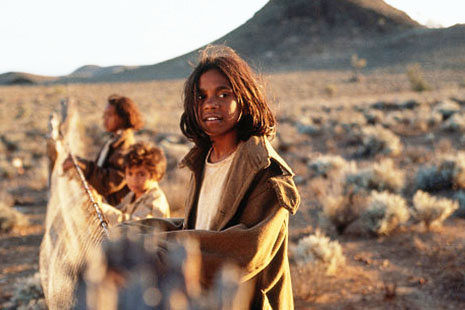
In feature films, Phillip Noyce’s Rabbit-Proof Fence (2002) was far and away more complex and convincing, far truer to history. In the same year, Ivan Sen’s superb Beneath Clouds was even better. Since then, in different ways, Rolf de Heer’s The Tracker and Ten Canoes have put Aboriginality at the centre of the screen, so it’s hardly as though Australia was breaking new ground. Consider also Michael Rowland’s wonderful Lucky Miles, a refugee story which wears its seriousness lightly, and Aboriginality is taken for granted as part of the scene; it’s simply not an issue. Consider too the range of Aboriginalities in the superb SBS series The Circuit, on dealing with law and lore in the Kimberley; in the sounds and images of First Australians – produced and co-written by Indigenous filmmakers and writers.
With Australia, one problem is announced in the title; there is a claim that this is, somehow, a representative tale. In fact it’s a disjointed mix of Gone with the Wind and a bad western. The fault is not centrally in the banal script or the flat performances of the two leads – Nicole Kidman is generally missing in action, Hugh Jackman not much better, while Bryan Brown, David Wenham and others deal with the cliches they’ve been handed by overacting shamelessly. It is rather that there’s no central drive or heartbeat, no sense of pressure from a story really needing to be told. Fine sets and costumes, great Kimberley gorges, stampeding cattle and Darwin under bombs: there are scenes to look at, but no urgency to hold them together. No orchestration, no ambiguity, no cinema: which is to say nothing to go on thinking about afterwards.
Ashenden discusses the inheritance from The Overlanders; there is also, more disquietingly, a line of connection back to Charles Chauvel’s Jedda (1955). Chauvel too wanted to seize on something essential about Australia; he too focused on the outback and Aboriginality, and chose the notion of a character doomed by her entrapment between two worlds. In the outcome, he too made a bad melodrama, but one which a good many Aborigines in outback Australia love, because it puts something of their own on the screen. Its many gaucheries have to do with the nature of production in a country without a film industry, without any climate for local cinema. That no longer holds; for Australia there are no excuses, and I can’t believe, as some appear to, that its commercial success or failure is a serious matter for the industry.
But Ashenden, pursuing the wider state of things, proposes that in all this there’s an elusive single narrative at work, a pivotal Australian story about black and white, “us and them.” For this story he sees no prospect of resolution, and he laments what he sees as its “endlessness.” He speaks of the way “the great Australian silence,” so incisively identified by W.E.H. Stanner in 1968, turned into a “great Australian din,” as whole cohorts of anthropologists, historians and storytellers at large spread revised understandings of the settler society’s history. He imagines a trajectory, and names its high points: the 1967 referendum, the Redfern Park speech of 1992, the best-selling Bringing Them Home report, the bridge walks for reconciliation, Cathy Freeman’s run. Evidently unable to imagine these as parts of separable, varying narratives, he says that the story of “us and them” is “a very difficult story to understand and even more difficult to tell”; he effectively acknowledges that “it” is in fact not one story at all, but many, since “it” is “complex and elusive in the form and in the morality of relationships between white and black, blotchy in its pattern, lurching and erratic in its trajectory.” But then, having admitted history’s unnevenness, he asks “who wants to hear a story of endless dashed hopes and interminable failure?”
The failure, in his reading of history and society, is that of a white Australian project which can be seen as continuous. “We” have tried this tactic, this policy and that, and all our devices come to nothing. As though the Aboriginal subjects were objects; as though they had nothing to say and nothing to do except wait for whatever “we” can think up next. But those were exactly John Howard’s working assumptions; over the decade of his reactionary government, successive moves toward supposed “mainstreaming” undermined native title (1998), educational provision (2004), Northern Territory land rights (2006), the place of customary law in criminal justice matters (2006) and most glaringly, in the summary abolition of the Aboriginal and Torres Strait Islander Commission (2005). In all that, Aboriginal people were consistently infantilised, excluded from discussion around each retrogressive move and shift. At this point, as we hope for that decade’s major damage to be repaired, we have to see that it was all deliberate ideology and politics. It was not, as Ashenden seems to be suggesting, irremediable fatality.
Perhaps he doesn’t mean to do a Howard, but he slides into assuming that all the strength, all the power of governance is on white Australia’s side. Not so, no more. No one in Australia has more moral authority than Patrick Dodson, Lowitja O’Donohue and their cohort; no one argues with more force in the public sphere than Marcia Langton, Noel Pearson or (disagreeing strongly with both of those about the value of the Intervention) Larissa Behrendt. At times, lamenting his imagined story’s “endlessness … it’s all there again in the morning,” Ashenden seems, like Howard, to wish they’d all go away.
Yes: there are thousands of shortened lives, some by suicide, many more by illness. There are unemployment, poverty and depression and futility, and attendant immersion in alcohol, marijuana and other destructive substances. There’s diabetes and there are people, older ones too, with permanent damage from petrol-sniffing. There’s drunkenness and brawling in communities where the elders, most often the grandmothers, are barely managing to hold things together; and the grandfathers, if they’ve lived long enough, agonise over social disintegration, and struggle hard to pass on to young males the law and morality they have inherited and lived by.
But as Gillian Cowlishaw writes: “The public outcry over Aboriginal violence and misery in Indigenous communities has exposed the intimate connections between ‘us’ and an imagined ‘them’ who are no longer silent and receptive to our administrations.” In her book Blackfellas, Whitefellas and the Hidden Injuries of Race, she analyses a particular episode of Aboriginal delinquency in the town of Bourke, and shows how destructive mayhem can be read as theatre, as performative resistance. The lads of that story – unskilled, ill-resourced for the white world – still rejected victimhood, and affirmed their own kind of Aboriginal survival with insubordinate hilarity.
There are also poverty, alienation and fecklessness in white Australia, and in back-country towns and suburbia many citizens, black, white and all skin-shades between, have in common lives marked by general hardship, precarious casualised employment, and tough dealings with Centrelink. And as Cowlishaw has argued, the colour line runs down the centre of many a marital bed, and indeed within particular human bodies. “Us and them”? It’s often us and us. There’s a wide scattering of young urban artists, performers, musicians for whom their Aboriginality, of whatever degree, is a side issue in their pursuits. For others, Aboriginal identity is essential to their self-presentation. In various careers, there are also young, dark-skinned optimists of mixed descent who’ll tell you they’re calling on the best of both worlds, for themselves and their children.
Because “the great Australian silence” was so decisively shattered, the fallout from invasion and dispossession has gravitated to the centre of national attention, and since 1996 Howard’s denialism – paradoxically, against his will – has assisted the process. It hasn’t been a comfortable one, and won’t be; but we have been stumbling toward to the truth of this country. We’ve begun to find out where we are: a much more difficult place than we were once taught to believe in, but also a much more interesting one. Some of the reasons for optimism can be found in the perennial, insistent drive toward recognition – and recognition was what the National Apology was most essentially about: not a point of arrival, but a new beginning.
Perhaps Dean Ashenden’s pessimism has another framework. Among Western intellectuals, not only in Australia, there’s a diffuse kind of gloominess around. It has a long, confused history, so familiar that we hardly imagine our world without it: the dismal, what-can-you-expect shrug response to almost any circumstance thwarting our projects. The life of the mind in Australia has developed in stony soil, siege mentalities settle in, and habitual pessimism is masked as realism. There’s a set of rigid, pre-set responses: nothing better is to be expected, and it is not imaginable that the climate can really change. But it can, it does; the successive defeats of Howard and Bush present opportunities to be taken. It still seems, at the beginning of 2009, as though many of the liberal left can hardly believe it.
More immediately, those who share Ashenden’s gloom on race relations can find relief quite easily. Attend an exhibition of Aboriginal art – somewhere outback, if you can get there, buy a painting you like, learn about its context and live with it. Spend some more money on good seats for the Bangarra Dance Theatre; or – much less expensive – spend a regular $2 on the National Indigenous Times and/or the Koori Mail, and get some news of the black resistance; that press gives us a lot more than football. Head for a Survival Day concert on 26 January, and find yourself actually enjoying Indigenous Australia. In one way and another, we are constantly delivered a double miracle: Aboriginal survival, and the Aboriginal will to forgive us all and share it.
Accepting those, and moving on from the Apology as its first anniversary approaches, Australia should be looking again at the United Nations Declaration on the Rights of Indigenous Peoples. With all our new Ruddite internationalism, we haven’t yet endorsed it. •